Railways

Name ID 514

1891

The first railway in the colony

Iliffe, J.A. Tanganyika under German Rule 1905-1912

Extract Date: 1891

See also

Extract ID: 1162

The first railway in the colony was built inland from Tanga after 1891

1892

The Baumann Map

Fosbrooke, Henry Arusha Integrated Regional Development Plan

Page Number: 121

Extract Date: 1892

See also

Extract ID: 3220

Paper IX: Early Maps of East Africa

Only a small portion of this map, which accompanied Dr. O Baumann's book "Durch Masailand zur Nilquelle" is reproduced. This map is of value as being the first drawn from personal observation. For Baumann actually travelled through the country, instead of relying on second hand accounts for his map making.

Of particular interest is his proposed Railways, running from southern slopes of Mount Meru, past the northern tip of Lake Manyara, and then south of the southern edge of a misshaped Ngorongoro. The line then proceeds across the Serengeti, south of Duvai (Olduvai) and Lake Ndutu and thence to Lake Victoria. This railway project has been discussed from time to time in the ninety years since it was first mooted. It is fervently hoped that the present discusions will be equally prolonged, until the planners come to realize that such a project would not only be an ecological crime but an economic absurdity.

1893 May 30

Construction begins of the Central Railway

Ofcansky, Thomas P and Yeager, Rodger Historical Dictionary of Tanzania

Page Number: xx

Extract Date: 1893 May 30

See also

Extract ID: 27

Chief Engineer Bernhardt arrives at Tanga and begins construction of the Central Railway.

1894-1911

the country's infrastructure

Map and Guide to Tanzania

Page Number: 06f

See also

Extract ID: 4028

Under the first appointed Governor General, von Liebert, the country's infrastructure was organised with administrative centres, schools, hospitals and other social facilities and roads, ports and Railways.

The l,250km long Central Line (Mittelland Bahn) between Dar es Salaam and Lake Tanganyika surveyed in 1894 was started in 1906, reached Tabora in 1912 and Kigorna in February 1914. The Usambara railway linking Tanga to Moshi (Nord Bahn) was built to develop trade with the northern plantations and was completed in 1911.

After that and until the outbreak of World War I, attention turned towards agriculture with the development of cotton, coffee, sisal and rubber plantations.

With the introduction of the railway network the Asian merchants consolidated their trade by installing themselves all over the interior of the country.

1896 April 1

Tanga-Muheza section of the Central Railway commences

Ofcansky, Thomas P and Yeager, Rodger Historical Dictionary of Tanzania

Page Number: xxi

Extract Date: 1896 April 1

See also

Extract ID: 1222

The Tanga-Muheza section of the Central Railway commences operation

1897-1903

Railway is completed to Korogwe

Ofcansky, Thomas P and Yeager, Rodger Historical Dictionary of Tanzania

Page Number: xxi

Extract Date: 1897-1903

See also

Extract ID: 1223

..the Tanga Railway is completed to Korogwe.

1898

to Kilimanjaro and Meru

Iliffe, J.A. Tanganyika under German Rule 1905-1912

Extract Date: 1898

See also

Extract ID: 1164

European agriculture accompanied it inland, reaching East Usambara in the early 1890s, West Usambara in 1898, and the great mountains - Kilimanjaro and Meru - shortly before the rebellion

1899 April 7

'Usambara Linie'

Ofcansky, Thomas P and Yeager, Rodger Historical Dictionary of Tanzania

Page Number: xxi

Extract Date: 1899 April 7

See also

Extract ID: 1225

The German Government, the DOAG, and the 'Usambara Linie' railway company sign an agreement whereby Berlin acquires the railway and its assets for 1,300,000 marks

1905

It reached Mombo

Iliffe, J.A. Tanganyika under German Rule 1905-1912

Extract Date: 1905

See also

Extract ID: 1163

It reached Mombo, below the foothills of Usambara, in 1905.

1905 April 6

The German government founds Company to operate the Tanga line

Ofcansky, Thomas P and Yeager, Rodger Historical Dictionary of Tanzania

Page Number: xxi

Extract Date: 1905 April 6

See also

Extract ID: 1224

The German government founds the German Colonial Railway Construction and Administration Company to operate the Tanga line.

1911

Settlement?

Iliffe, J.A. Tanganyika under German Rule 1905-1912

Extract Date: 1911 February

See also

Extract ID: 1155

In practice, what mattered was not the Colonial Secretary's public statements with regard to settlement, but his administrative decisions on the problems which it presented. The first of these was the northern railway. When Dernburg conceded the building of the line from the River Pangani to Moshi, he insisted that this must be the terminus.

Right- wing opinion disagreed. In February 1911 the Colonial Society petitioned the Reichstag for extension to Arusha, and in July it revived the old idea of a line to Lake Victoria. Rechenberg had long opposed these views, but Lindequist accepted the Arusha line in principle, a decision which was to bind his reluctant successor.

1912 February 7

extension to Moshi officially opens

Ofcansky, Thomas P and Yeager, Rodger Historical Dictionary of Tanzania

Page Number: xxi

Extract Date: 1912 February 7

See also

Extract ID: 1226

The Tanga Railway's extension to Moshi officially opens.

1919 April 1

British civil administration assumes responsibility

Ofcansky, Thomas P and Yeager, Rodger Historical Dictionary of Tanzania

Page Number: xxi

Extract Date: 1919 April 1

See also

Extract ID: 1227

British civil administration assumes responsibility for all mainland Railways.

1920-29

Railway Annual revenues

Arusha: A Brochure of the Northern Province and its Capital Town

Page Number: 20

Extract Date: 1920-29

See also

Extract ID: 1229

Annual revenues pounds

1920 108,000

1921 157,000

1922 197,000

1923 223,000

1924 238,000

1925 333,000

1926 388,000

1927 461,000

1928 581,000

1929 704,000

projected

1939 2,500,000

'if we pull together'

Advertisment

1929

The extension of the railway from Moshi to Arusha

Gordon-Brown, G (Co-Editor) The Year Book and Guide to East Africa (1927)

Extract Date: 1929

See also

Extract ID: 53

The extension of the railway from Moshi to Arusha was completed in 1929. [the line from Tanga to Moshi was started in 1891 by the Germans and completed in 1911].

1929

Arusha: A Brochure of the Northern Province and its Capital Town

Arusha: A Brochure of the Northern Province and its Capital Town

Page Number: 00

Extract Date: 1929

See also

Extract ID: 15

Front Cover

Published on the occassion of the opening of the Railway on 5th December 1929, by His Excellency Sir Donald Cameron, K.C.M.C., K.B.E., and to commemorate the First Session of the Legislative Council of the Tanganyika Territory at Arusha.

1929

Arusha Railway. Bridging the Tengeru River

Arusha: A Brochure of the Northern Province and its Capital Town

Page Number: 16a

Extract Date: 1929

See also

Extract ID: 3409

1929

Settlement and Projected Railways

Arusha: A Brochure of the Northern Province and its Capital Town

Page Number: 19

Extract Date: 1929

See also

Extract ID: 21

Although the areas immediately around Kilimanjaro and Meru are fairly well settled, it is by no means closely settled and there are still areas unused and which may become available for alienation.

There are however, definite areas open to settlers in the "Ufiome Triangle" and Mbulu, and these areas are fast becoming settled. There is little doubt that at no distant future these districts will be served by a railway connecting Arusha with the Central Line.

Arusha, there is little doubt, will not remain the railhead for any great period. Government have in view a connection with the Central Line, but whether this projected line will run via Mbugwe, Kondoa Irangi and Dodoma or via Mbugwe, Singida and Manyoni, is at present not decided on. Gen. Hammond and the General Manager of the Tanganyika Railways recently discussed the projected line with local public bodies who were in favour of the latter route.

In either case the projected line will tap the rich "Ufiome Triangle" and the highlands west of the Rift Valley escarpment. Fifty to Sixty farms have been taken up in recent years in the sub-district of Mbulu, both above and below the escarpment.

There is also under consideration a branch from the Moshi-Arusha line to Engare Nairobi on the western slopes of Mount Kilimanjaro, and such line it is hoped, will later be joined with the Kenya and Uganda Railway near Kajiado, thus shortening the north and South route considerably and making direct communication with the Kenya capital.

1929 December 13

The Moshi-Arusha portion is opened

Ofcansky, Thomas P and Yeager, Rodger Historical Dictionary of Tanzania

Page Number: xxii

Extract Date: 1929 December 13

See also

Extract ID: 1228

The Moshi-Arusha portion of the Tanga Railway is opened to traffic.

1954

East African Railways and Harbour Board

Green, Geoff Capital Capers

Page Number: 05

See also

Extract ID: 3357

1954~


Marsh, R.J. & E.P. Photos of Arusha Environs

Page Number: 011

See also

Extract ID: 3877

2002

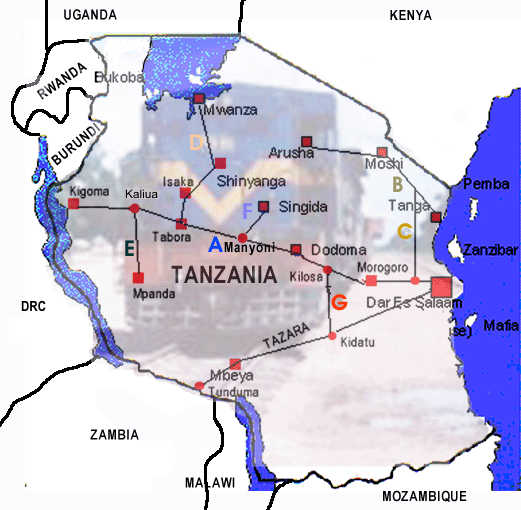
Railway Network

Official website of Tanzania Railways Corporation

Page Number: 1

Extract Date: 2002

See also

Extract ID: 3516

A = Central Line

B = Tanga Line

C = Link Line

D = Mwanza Line

E = Mpanda Line

F = Singida Line

G = Kidatu Line

2002

Arusha Station

Official website of Tanzania Railways Corporation

Page Number: 2

Extract Date: 2002

See also

Extract ID: 3515

General Information

Arusha Municipality is at the terminus of the Tanga Line, to the west of Tanga. It is the administrative headquarters of Arusha Region, situated at the foot of Mount Meru, the second tallest mountain in Tanzania next to the Kilimanjaro. Arusha is the hub of the northern tourist circuit of Tanzania, offering regular tours to Ngorongoro Crater, Ngorongoro Conservation Area, Serengeti National Park, Soronera, Lake Manyara National Park, etc. Furthermore, Arusha is on the Great North Road, midway from Cape to Cairo; and is host to the prestigious Arusha International Conference Center as well as the headquarters of the East African Community.

Railway History and Operations.

Construction of the 86.08 km Moshi-Arusha railway extension of the Tanga Line starting at Moshi in 1911 and reaching Arusha in 1929. The railway distance from Arusha to Tanga and Dar es Salaam is 437km and 644km respectively.

Main features at Arusha include:

Arusha Railway Station including passenger and parcels terminal Goods Shed for consigning and receiving goods.

Other attractions include:

Easy access to the world-famous national parks of Ngorongoro, Serengeti, Manyara, etc.

Modern conference facilities at The Arusha International Conference Centre

Headquarters of the East African community

24 Dec 2007

Tanzania’s northern rail route to be revamped

Author: MOHAMED ISSA MOHAMED

Internet Web Pages

Extract Date: 24 Dec 2007

external link

See also

Extract ID: 5469

The East African

Tanzania’s scenic northern railway lines linking the rich hinterlands of Arusha and Moshi to the port of Tanga is to be revived.

This is contrary to earlier reports that the firm would shut down the route, said the firm’s managing director, Narsimhaswami Jayaram.

However, heavy maintenance and a complete overhaul of some of the sections on the stretch will have to be done.

Mr Jayaram said a survey conducted recently showed that the ageing railway is in dire need of refurbishment.

“The tracks are in a very poor condition,” he said.

He added that the Tanga line is an important route for transport of minerals and cement and will be improve and rehabilitated alongside the entire railway.

The line used to ferry coffee and tea exports from Arusha and Kilimanjaro regions to Tanga. It has many rail sidings that link the Tanga port with factories, flour mills and a city-based industrial area, Gofu.

The sidings ease transportation of raw materials imports such as coal and clinker for the Tanga Cement factory and bulk grain for Pembe Flour Mills.

It is an integral part of a rail-marine transport corridor; Tanga-Arusha-Musoma-Port Bell/Jinja (Uganda) currently being initiated by the East African Community.

The 437-kilometre railroad was built by the Germans a century ago and has never been renewed.

Tanzania Railways will replace the defective portions of the line and deploy new coaches, wagons and locomotives. Passenger and cargo trains schedules are expected to start mid next year.

Tanzania’s entire rail network is about 2,600km long. The central line runs from Dar es Salaam to Kigoma, and the Tanga line from port town to Moshi.

The central line has further branches, including one to Lake Victoria, where it connects with the Uganda Railway through wagon ferries.

From the Tanga line, a connection goes north to Kenya, terminating at Taveta.

Tanzania Railways Ltd (TRL) is a partnership between India’s Rites consortium and a state-owned Reli Assets Holding Company. It started managing the country’s railway in October.

Rites has bought 51 per cent of the shares of the phased-out Tanzania Railways Corporation, while the government of Tanzania retains the remaining 49 per cent.

TRL will run the rail under a 25-year concession under the supervision of the Surface and Marine Transport Regulatory Authority.

The World Bank recently disbursed a $33 million loan for the initial rehabilitation of the railroad and rolling stock, which comprises 90 locomotives, 1,280 freight wagons and 110 passenger coaches.

Tanzania has two railway systems. The other one is the Tanzania-Zambia Railway Authority, which runs 1,860 km from Dar es Salaam to Kapiri Mposhi in northern Zambia.

www.nTZ.info