Book ID 327
In 1930 …
some german farmers got permission to root out the bush on the southern slopes of Mt. Oldeani and Ngorongoro-Crater wich were not inhabitat in those days. One of the newly established farms was later named "Shangri-La", after the famous novel "Lost Horizon" of James Hilton. Being an english possession for a relatively short period after World War 2, not only Shangri-La, but also some other plantations were rebought by a Danish-German group, who invested a substantial amount to revitalize the old neglected farms.
Nowadays [2006~]
this investor group is represented by its owners Christian Jebsen and Dr. Günter Klatt. The familiy Jebsen has a long link of over 100 years with Tanzania and Dr. Klatt made some historical studies about the country. With their Karatu-Developement-Foundation company ( KDF), they are eager to promote the three sections of the farm: coffee, vegetables and dairy. These products are supplied to hotels and lodges. Local people also benefit, as the farm is one of the biggest employers in Karatu.
Irish Olympic Council
This in fact brought a very special moment in Olympic history for Ireland. Within the short space of an hour Ireland won two Olympic gold medals on Monday, August 1st, 1932.
The first was won by Robert Morton Newburgh Tisdall, always known as simply Bob, who, although he was born in Ceylon, was thoroughly Irish by his lineage. His Olympic victory had the element of a fairy-tale about it.
Early in 1932, he wrote to General Eoin O'Duffy, then the President of the Irish Olympic Council and asked to be considered for the Irish Olympic Team in the 400 metres hurdles and he also confessed that he had not previously run in the event.
O'Duffy was immensely taken by the letter and later invited Tisdall to compete in a special Olympic trial at Croke Park in Dublin. Tisdall failed to make the qualifying time but O’Duffy gave him another chance and Bob Tisdall qualified for the Irish Team by winning the National 440 yards hurdles title at the Irish Championships also at Croke Park.
After winning his preliminary Olympic heat in Los Angeles, Bob Tisdall equalled the Olympic record of 52.8 seconds in the semi-final and then in the final, despite stumbling at the final hurdle, he won the Olympic gold medal in 51.7 seconds which would have been a world record but for the fact that he had knocked over the last hurdle and under the laws prevailing at the time this ruled out recognition of a world record.
Men's 400m. Hurdles Final. Olympic Games 1932
1. Robert Tisdall (IRL) 51.7 WR
2. Glenn HARDIN (USA) 51.9
3. F. Morgan TAYLOR (USA) 52.0
4. David BURGHLEY (GBR) 52.2
5. Luigi FACELLI (ITA) 53.0
6. Johan Kjell ARESKOURG (SWE) 54.6
RTE web site, taken from Modern Irish Lives: Dictionary of 20th-century Biography, Louis McRedmond (General Ed.), Gill & Macmillan, Dublin, 1996
ROBERT MORTON NEWBURGH (Bob) Tisdall (1907 - ) athlete
Born 16th May 1907, Nuwara Eliya, Ceylon (now Sri Lanka)
Born to an Anglo-Irish family, he was raised in Nenagh, County Tipperary. He had run only six 400m hurdles when he won the gold medal at the 1932 Olympic Games in a world record time of 51.7 seconds, which was not recognised under the rules of time because he had a hit a hurdle. Earlier, while at Shrewsbury, he won the Public Schools 440 yards, and at Cambridge he won a record four events - 440 yards and 120 yards hurdles, long jump and shot - in the annual match against Oxford.
He set South African and Canadian records in the 220 yards low hurdles in 1929, a year later setting Greek records in the same event. While at Cambridge in March 1932, he decided to try for a place in the Irish Olympic squad and after he ran 54.2 seconds (a record) for the Irish Championship 440 yards hurdles in June that year, the authorities agreed to let him run in his new event at the Los Angeles Olympics, where he also came eighth in the decathlon. He eventually settled in Queensland, Australia.
The Royal Scottish Geographical Society
Medalists and Award Winners
Centenary Medal (The Society's Research Medal, renamed the Centenary Medal in 1988)
In recognition of outstanding contributions in the field of Geographical enquiry and the development of Geography as a discipline.
Centenary Medal
1936 Clement Gillman
Sliders FAQ 2nd Edition: General Questions
Rhys-Davies went to school in Truro, Cornwall. His father had gone out to Africa after World War II, and the rest of the family joined him a few years later. It was in Tanzania, then called Tanganyika. He grew up partly on the coast, partly by Kilimanjaro, until he was sent back to England to be educated. He did not want to grow up in England, and wanted to go back to Africa and become a district commissioner and shoot things in the bush, he said in an SFX interview. He says that he has a hunter's values.
Author: Bob Tisdall
Internet Web Pages
Extract Date: 1960
See also
Extract ID: 3861
Bob Tisdall, Olympic Gold Medallist, 400mH, 1932, in An Olympic Memory, Rome 1960
"Sport can open up a door, as it were, between men. The world is full of closed doors and drawn curtains, and this Olympic door must therefore never be closed. And those symbolic rings emblazoned above it must be kept bright and shining to bring that peace and goodwill for which the world is craving."
On 11 September 1963, the Karatu meteorite fell at Tlae Daat, near Karatu, Arusha, Tanzania. A single stone of 2.2 kilograms was recovered. Karatu is an ordinary LL6 chondrite. The LL chondrites are somewhat lower in total iron content than 90% of the ordinary chondrites (e.g., the H and L chondrites). Like all ordinary chondrites, the LL chondrites are believed to be fragments of small or medium sized disrupted asteroids.
This meteorite fell in Arusha, Tanzania, on 11 September 1963, and witnesses found only one stone weighing a scant 2.2 kilograms. Karatu is an Ordinary chondrite, LL6, is beautifully brecciated, and has a light gray matrix with very little metal flecking. It is seldom available to collectors as virtually all of it remains in museums.
The web site belongs to Schoolers, a mmineral, fossil and meteorite dealer. In March 2007 they had five fragments displayed (2 sold). .09g, 6.58g, 5.71g, 1.81g and 3.02g. Other sites, including ebay, are selling fragemnts of the meteorite.
Author: Tanzania Tourist Board
Internet Web Pages
Extract Date: 1964
See also
Extract ID: 5559
The word Tanzania is derived from the two nations of Tanganyika and Zanzibar which before 1964 were separate.
Tanganyika in Kiswahili, the local dialect (Swahili) is translated to mean "sail in the wilderness"
and Zanzibar is derived from the Arabic words "Zayn Z'al Barr" which mean "fair is this land".
Tanzania Tourist Corporation (TTC) was established in 1969. The TTC's role is to oversee the operation of hotels and other tourist facilities. Also, to head the marketing of tourism in Tanzania.
Lost the link for this, so not sure where this came from.
Author: Nettelbeck, David C
Internet Web Pages
Extract Date: 1974
See also
Extract ID: 3728
THESES record number: T1053
Title: A history of Arusha School, Tanzania
Author: Nettelbeck, David C.
Award: M.Ed.
Department: Education
Thesis: Thesis
University: University of Adelaide
Year: 1974
Location: SAEM RARE 371.009678 N473H
Subject Heading: UNIVERSITY OF ADELAIDE MASTER OF EDUCATION THESES [513]
UNITED STATES COURT OF APPEALS FOR THE ELEVENTH CIRCUIT
Our conclusion [in the main case] finds significant support from Burke v. National Broadcasting Co., Inc., 598 F.2d 688 (1st Cir. 1979). Burke captured on film a highly unusual and dramatic encounter in which a zebra attacked a lioness who had killed the zebra's foal. Grzimek, a professor and a host of an educational television program, wrote Burke requesting permission to use the film in his lectures and in the educational television program. Burke responded affirmatively, sending Grzimek the film accompanied by a short reply that contained neither express authorization nor express restriction with respect to other possible uses of the film. Grzimek initially used the film only for the stated purposes, but later transmitted a copy of the film to a commercial company specializing in nature films, which in turn sold a production that included the film to NBC. The issue was whether Burke's common law copyright was forfeited to the public domain by virtue of the circumstances surrounding his seemingly unconditioned release of the film to Grzimek. In other words, the issue was whether there had been a general publication. The First Circuit held that only a limited publication had occurred, and that Burke's common law copyright had not been lost.
Internet Web Pages
Extract Date: 1992 onward
See also
Extract ID: 1432
Ngorongoro Sopa Lodge
Location
Ngorongoro Sopa Lodge is located on Lemala Hill on the eastern rim of the Ngorongoro Crater at 3°10'S and 35°42'E in the volcanic highlands of Northern Tanzania.
The crater forms part of the Ngorongoro Conservation Area, an area of 8,300 square kilometres (3,200 square miles) set aside to preserve and integrate the diverse interests of wildlife, people, forestry, archaeology and tourism.
Ngorongoro Sopa Lodge is the only tourist development on the previously undisturbed eastern side of the crater and is located on the eastern access road to the crater. The descent to the crater floor commences within five minutes of leaving the lodge.
Climate
The lodge is situated at 7,800ft (2,375 metres) above sea level and is therefore cool and even cold at certain times of the year. However, most days throughout the year have some sunshine, and sunbathers must take care at this altitude. Low cloud or early morning mist sometimes hides the crater, most times clearing unexpectedly to reveal spectacular views into and across the crater. June and July are the coldest months, and the rains of November and May bring out a profusion of wild flowers and lush grazing.
Accommodation
Ngorongoro Sopa Lodge, opened in 1992, is an all-suite lodge with 100 suites, all of which enjoy magnificent views into the crater. Each suite is fully carpeted and heated by oil fired central heating radiators. The spacious bedrooms contain two queen sized (5ft) beds with deep sprung mattresses to ensure a comfortable night's rest.
The fully tiled bathrooms are equipped to a very high standard with baths, showers, WCs, bidets, hand basins, hair driers and shaver sockets. Each suite has an enclosed 'solarium' with comfortable rocking chairs - the perfect place to relax.
A small private lounge with a writing desk and a drinks refrigerator provides extra privacy to the suite.
Transportation
To reach the lodge, one takes the newly tarmaced main Dodoma road for 80 kilometres before turning off at Makuyuni and proceeding on all-weather roads via Mto wa mbu, Manyara and Karatu to the Ngorongoro Conservation Area. Climbing up the mountainous slopes to the crater rim at View Point, the new all-weather road to the lodge is 20 kilometres of scenic delight along the crater rim. The journey from Arusha to the lodge is approximately three-and-a-half hours long.
The flight to Ngorongoro takes approximately 40 minutes. The air strip is located on the western side of the crater, approximately 45 minutes away by road. There are plans to construct an air strip on the eastern side of the crater close to Ngorongoro Sopa Lodge. Cloud conditions can sometimes affect the availability of the air strip at Ngorongoro causing diversion or rescheduling to Manyara or Olduvai.
Electricity
The lodge has a number of generators which provide electric current throughout the day and night. The current is 240 volts 50 cycles.
Water
Water for lodge usage is obtained from bore holes and from the Munge River, but guests are advised not to drink tap water. Vacuum flasks or filtered water are placed in each suite and bottled water is available for sale in the lodge.
Children
Sopa Lodges welcome children and can arrange for special children's meals at times which are suitable to each individual.
Guest shop
The main lobby houses a guest shop with a wide selection of curios, gift items, safari clothing, film and a selection of guest requisites.
Clothes
As the lodge is situated at 7,800ft above sea level, the evenings and early mornings can be cool and sometimes cold. It is recommended that guests bring a sweater or a light jacket. However, it should be noted that on crater visits the temperature is much higher. All suites are centrally heated and the public areas of the lodge feature large log fires. The main areas of the lodge have an atmosphere which may encourage guests to wear something special for the evening.
Swimming pool
Located on the very edge of the crater rim, the water is bracing, but refreshing in the warmer months. Sunbeds and comfortable poolside furniture allow the less brave to enjoy the spectacular views and high altitude sunshine without getting wet.
Petrol station
The lodge can at present supply diesel fuel and will shortly have a petrol supply. Minor repairs can be carried out by the lodge mechanic, although guests are advised to ensure that their vehicles have been correctly maintained prior to the safari.
Crater tours
The lodge has a number of four-wheel drive vehicles for hire for trips to the crater or other excursions. Full-day, half-day, early morning or sundowner trips can be pre-booked or arranged at the lodge. The Ngorongoro Conservation Area Authority maintain an office at the lodge to provide information and issue the necessary permits for entry into the Conservation Area and to the crater.
Excursions and nearby places of interest
Empakaai Crater is approximately two hours' drive on a dirt road from the lodge. It is a totally unspoilt, rarely visited mountainous crater region, with unsurpassed views of the still active volcano Ol Donyo Lengai and north over Lake Natron.
Olmoti Crater, yet another rarely visited crater, is approximately one hour's drive from the lodge. Here, guests can hire a guide and walk up to the crater rim.
Olduvai Gorge, the famous archaeological site, is about one-and-a-half hours' drive from the lodge. The site houses a visitor centre and a museum.
Conferences
A 2,500 square foot conference facility is available for conferences, meetings, presentations, private lunches or dinners and cocktail parties. Situated on a level above the main lounge it enjoys the most spectacular views of the crater.
Special occasions
The lodge is capable of providing a wide range of additional options for special occasions, from a birthday or anniversary cake to special dinners, large parties, bush breakfasts, sundowners, barbeques and African Theme Nights.
Communications
The lodge is connected to Arusha by radio link. Video and satellite television is available.
Coffee shop
The coffee shop is situated in the main lobby, and provides tea and coffee for guests from early morning until late. Afternoon tea is a speciality.
Sopa hospitality
All the management and staff of the lodge are committed to looking after guests and to ensure that their stay is comfortable and enjoyable. Our policy of friendly helpfulness is planned to make each and every guest feel welcome and cared for during their stay. Our aim is to provide the type of hospitality which complements the magnificent natural beauty of Ngorongoro Crater.
Reservations
Reservations can be made through any travel agent or tour operator, or through the Central Reservations Office in Arusha.
Telephone: Arusha 6886/6896
Fax: Arusha 8245
PO Box 1823, Arusha, Tanzania
or through Kenya Holiday Management Services
Telephone: Nairobi 336724/337410
Fax: Nairobi 331876
PO Box 72630, Nairobi, Kenya
Ngorongoro Sopa Lodge is managed by:
Sopa Management Ltd
PO Box 1823
Arusha
Tanzania
a wholly owned subsidiary of Consolidated Tourist & Hotels Investment Limited
Author: Wolf Roder
Internet Web Pages
Extract Date: 1995 June 1
See also
Extract ID: 246
University of Cincinnati
I think the following should be mentioned: Roland Arnold Young and Henry Fosbrooke,
'Smoke in the Hills: political tension in the Morogoro District of Tanganyika' (Evanston: Northwestern U. Press, 1960)
This is a singularly inept title. The book is in fact about violent and other resistance to terracing and other conservation measures in Morogoro. I remember the introductory chapter talking about conservation measures in eastern Africa in general.
Found in a newsgroup thread. Lost the link.
Latham, a physician, stepped down several years ago as director of Cornell's Program in International Nutrition after 25 years. An expert in international nutrition and tropical public health, he also is author of several books, including Kilimanjaro Tales: The Saga of a Medical Family in Africa, Human Nutrition in Tropical Africa and Human Nutrition in the Developing World, and more than 350 journal articles. He frequently serves as a consultant in Africa, Asia and Latin America for WHO, FAO, UNICEF, the World Bank and the White House. In 1994, he consulted with Fidel Castro on how to curb Cuba's neuropathy epidemic.
In 1965 at age 37, Latham was awarded the Order of the British Empire by Queen Elizabeth II for his work on developing the nutrition unit. The award also recognized his leadership in establishing the International School, an integrated primary school in Dar es Salaam.
Latham, a physician, was born in Tanzania and studied medicine at Trinity College in Dublin. He received a degree in tropical medicine and hygiene from London University and a master of public health degree from Harvard University.
From 1955 to 1964 he was district medical officer and director of the nutrition unit of the Ministry of Health in Tanzania. In 1965 he was awarded the Order of the British Empire for distinguished service. He joined the Cornell faculty in 1968 after four years at Harvard.
Latham has authored more than 350 journal articles as well as several books. One of his books, Kilimanjaro Tales: The Saga of a Medical Family in Africa, combined his and his mother's accounts of their life in Tanzania when he was a boy.
Wild Arabica Coffee was introduced in Tanzania by Christian missionaries from the Island of Re-union (Bourbon) between 1980s [sic] and 1890s, and was first grown at Kilema Mission on the slopes of Mt. Kilimanjaro.
Coffee spread slowly to other regions of Tanzania and later to Kenya, thus crowning Tanzania as the `Mother' of Coffee culture.
For years, Coffee has been Tanzania's primary forex earner, providing the country with between 26 and 35 per cent of its foreign income
Lost the link for this, so not sure where this came from.
Author: Robert Weiss, Palo Alto, California
Internet Web Pages
Extract Date: 8 February 1998
See also
Extract ID: 3798
Background
The following is a roster of the 500 Polish children who were removed from Poland and sent to an orphanage in the Union of South Africa, where they remained until after the conclusion of the Second World War. There is great interest on the part of Holocaust survivors in determining their origins, especially difficult task when information on their parents or their place of origin is unknown. I hope the publication of this list may help in their search.
History
On 17 September 1939, two weeks after the German invasion of Poland, Soviet troops swiftly occupied the eastern half of Poland and, after a plebiscite, annexed the area to the Ukraine and Belorussia. Beginning in the winter of 1939-40 Soviet authorities deported over a million Poles, many of them children, to the various provinces in the Soviet Union. Almost one third of the deportees were Jewish.
For a description of the life of the deportees during this period the reader is referred to the Hoover Archival Documentary War Through Children's Eyes, a collection of essays written by the children like the subjects of this paper.
In the summer of 1941 the Polish government in exile in London received permission from the Soviet Union to release several hundred thousand former Polish citizens from labor camps, prisons and forcible resettlement in the Soviet Union, to organize military units among the Polish deportees, and later to transfer Polish civilians to camps in the British-controlled Middle East and Africa. There the Polish children were able to attend Polish schools.
In 1942, the London government, acting through their Consul General Dr. Mi. Stanislaw Lepkowski, secured permission from the government of the Union of South Africa to transport 500 of the estimated 220-250,000 children to that country. In 1943, after they had been evacuated through the southern Soviet republics to Iran, the children were brought to South Africa.
The Polish Children's Home (Dom Polskich Dzieci) was organized in Oudtshoorn for their temporary accommodation, care and education. Under the supervision of the South African Department of Social Welfare, as well as Polish consular and ministry representatives, it remained in operation until 1947.
[snip]
Also in October of 1944, arrangements were made with the East African Refugee Administration to transfer another small group of nine children to Polish camps in Bwana Mkubwa, Abercorn and Lusaka, Northern Rhodesia to rejoin their families. The transfer took place early in 1945.
Some time in 1944 another, large, transfer was made of 115 children to camps in Kenya. The lists document the entry into Kenya of 43 children to Camps in Tengeru, 43 to Masindi, 21 to Koja, 5 to Ifunda, 1 to Morongo or Rongai and 2 to Kidugala.
Internet Web Pages
Extract Date: 1999 September 2
See also
Extract ID: 1396
CNN ARUSHA, Tanzania (Reuters)
All 10 U.S. tourists aboard a light aircraft died when it smashed into a mountain near a Tanzanian game park, rescue officials said on Thursday.
'They are still looking around the site, but there is no hope of finding survivors,' an official told Reuters. He said they had found 10 identifiable bodies and the scattered remains of two other people.
The Cessna aircraft belonging to Northern Air went down about 11 a.m. (0800 GMT) on Wednesday as it took the tourists from Serengeti national park to an airport near Mount Kilimanjaro, Africa's largest mountain.
Rescuers who worked through the night to reach the crash site said the plane smashed into Mount Meru at 2,580 metres (8,500 feet) and appeared to have burst into flames.
'They found the plane wreckage at around 4 a.m. (0100 GMT),' said Margaret Muyangi, head of Tanzania's Civil Aviation Authority. 'It was very foggy and difficult to work out there.'
On Wednesday, a U.S. embassy spokesman in Nairobi confirmed that 10 Americans -- six men and four women -- were on board the aircraft along with a Tanzanian tour guide and a pilot whose nationality he did not know.
Visitors were on luxury tour
The spokesman said the tourists, three couples and a group of four came from Florida, Massachusetts, Connecticut, California and New Jersey.
Seven other American tourists from the same group but on a different plane arrived safely at Kilimanjaro Airport.
They had been on a luxury tour organized by Abercrombie & Kent, staying at the Serena Wildlife Lodge, an upmarket safari camp in the Serengeti.
The crash site was on the southeastern slopes of Mount Meru, a 4,565-meter (14,979-foot) high mountain 50 km (30 miles) west of Kilimanjaro.
Kilimanjaro, although close to the equator, is permanently snow-capped and both mountains are frequently shrouded in heavy cloud.
The Serengeti draws tens of thousands of tourists every year who come to see its wide range of big game animals and the annual migration of millions of wildebeest.
Mount Kilimanjaro, which stands at 5,895 metres (19,347 feet), also attracts thousands of hikers and climbers.
In Washington, the State Department said it was notifying the families of the 10 American tourists listed as passengers.
Copyright 1999 Reuters Limited. All rights reserved.
I think this was on a CNN news page.
Internet Web Pages
Extract Date: 14 October 1999
See also
Extract ID: 3881
Press Coverage from the Internet. Follow the link to load a MS Word Document (113 pages 663KBytes.) About 100 articles.
Julius Nyerere
14 October 1999
ANC Statement On The Death Of Julius Kambarage "Mwalimu" Nyerere
African National Congress of South Africa
PanAfrican News Agency
Tanzania's First President Dies In Britain
WorldBank
James D. Wolfensohn Statement On The Death Of Julius Nyerere
15 October 1999
BBC
Tributes pour in for Nyerere
Julius Nyerere: The conscience of Africa
E-mails tell of Nyerere's honesty and humility
Text of President Mkapa's address to the nation
Nyerere: A personal recollection
Songs of grief for Tanzania's founder
Tanzania prepares for Nyerere funeral
Independent
Julius Nyerere, the elder statesman of post-colonial Africa, dies, aged 77
Third World visionary who brought socialism to the villages
'I learnt at his feet ... he was our guru'
The Nation (Nairobi)
A Symbol Of Africa's Hope
The Times Of Zambia (Lusaka)
Tanzanians say goodbye to Mwalimu
The Times
Julius NYERERE
Guardian
Africans mourn death of the father of Tanzania
The Independent
OBITUARY: Julius NYERERE
16 October 1999
Panafrican News Agency
President Clinton Pays Tribute To Nyerere
Nyerere To Be Laid To Rest At His Butiama Home
The Times of Zambia (Lusaka)
We've been robbed of great leader-- Chiluba
Financial Times
Guardian
Idealism in a cynical world
The Nation (Nairobi)
Mwalimu Nyerere's bequest to Mkapa a tall order
17 October 1999
The Monitor (Kampala)
Kwa heri, Mtukufu Rais Julius K. Nyerere
Panafrican News Agency
Tanzanians In UK Bid Farewell To Nyerere
World Leaders Continue To Send Condolences
The Nation (Nairobi)
Mwalimu's rise to power
Mwalimu's enduring legacy
Independent on Sunday
18 October 1999
Guardian
Julius Nyerere
Richard Gott writes:
Simon Barley writes:
Ronald Segal writes:
Chandra Hardy writes:
BBC
Email tributes
HYPE
The Meaning Of "Mwalimu"
Panafrican News Agency
Half A Million Tanzanians Welcome Nyerere's Body
Museveni To Lead Delegation To Nyerere's Funeral
19 October 1999
Guardian
Nyerere's return
The Times
Thousands flock to see Nyerere's coffin come home
New Vision (Kampala)
Nyerere Body Arrives In Dar
The Times of Zambia (Lusaka)
Chiluba declares four-day national mourning
20 October 1999
Independent
Tanzania weeps for father of the nation
BBC
World leaders arrive to honour Nyerere
Julius Nyerere: Political messiah or false prophet?
Panafrican News Agency
Nyerere's Daughter Denied Holy Communion
Wrangle Over Nyerere's Final Resting Place Solved
18 Heads Of State To Pay Respects To Nyerere
The Monitor (Kampala)
Dreams that never died
21 October 1999
BBC
World leaders honour Nyerere
Panafrican News Agency
Academician Revisits Nyerere's Development Vision
Rwandan TV Airs Nyerere's Funeral Ceremony Live
22 October 1999
Guardian
The world turns out to honour Nyerere
Independent
Nyerere, flawed fighter of colonialism, buried as hero
The Times
Leaders pay their repects to Nyerere
New Vision (Kampala)
World Pays Last Respects To Mwalimu Nyerere
Museveni Joins World In Mourning Nyerere
The Monitor (Kampala)
Big farewell for Nyerere
Business Day (Johannesburg)
Tanzania And The World Say Their Farewells To Nyerere
The Times of Zambia (Lusaka)
Nyerere was a great African statesman - Chiluba
Panafrican News Agency
Tanzanians Pay Homage To Nyerere On Eve Of Burial
Nyerere Provided Haven For Late Banda's Opponents
Downpour, Wind, Mark Arrival Of Nyerere's Body
23 October 1999
Economist
Julius Nyerere
Guardian
Tanzania's unity weakens without Nyerere
Panafrican News Agency
The Road Ends For One Of Africa's Greatest Sons
BBC
Nyerere laid to rest
24 October 1999
The Monitor - Kampala
Mandela to visit Nyerere's grave
Nyerere's not so sweet side
The Nation.
Remembering a great son of Africa [Analysis]
Canto for hope
Panafrican News Agency
The Road Ends For One Of Africa's Greatest Sons
26 October 1999
The East African
As 'Kingmaker' Dies, Whither Tanzania Politics and Society
Ever the Idealist, Nyerere's Legacy is Everlasting
There Was Real Freedom in Mwalimu's Day
Painful Loss of a Friend, Mentor and Nationalist Par Excellence
Death Puts Nyerere Biography in Limbo
Leaders Pay Tribute to Mwalimu
Sporting Events Postponed in Honour of Nyerere
27 October 1999
Panafrican News Agency
Spirit Sends Soldiers Scampering For Safety
Business Day (Johannesburg)
Nyerere No Great Leader, But Ensured Poverty For Tanzania (Column)
28 October 1999
Southern African Research and Documentation Centre
Mwalimu Julius Kambarage Nyerere- A Remembrance
Southern African Research and Documentation Centre (SARDC)-
Address To Members Of Parliament: By Mwalimu Julius K. Nyerere
UN Integrated Regional Information Network
IRIN Focus on the union
29 October 1999
All Africa News Agency
Julius Nyerere: A Concrete Example Of Commitment
Who Else Would Get The Credit For Peace And Unity?
The Day The Villagers Lost Their Favourite Son
Panafrican News Agency
Tanzanian Authorities Crackdown On Poachers
The East African
He Did Not Think His Life Was in Danger
South Africa Remembers Nyerere as One of Its Own
Balancing Relative Values at the Funeral (Opinion)
A Legacy of Unity, But Not of Democracy (Opinion)
Why Mwalimu Never Went Out of Fashion (Opinion)
Coach Nyerere is Gone, the Team Must Play On
30 October 1999
Panafrican News Agency
Nyerere Mourning Regulations Relaxed
Miscellaneous
Saints and Presidents: A Commentary on Julius Nyerere
Author: Nichole Smaglick (?)
Internet Web Pages
Extract Date: 2000 June
See also
Extract ID: 5405
The Honeyguide Newsletter
The words 'Mt. Kilimanjaro' conjure up romantic images of personal growth, challenge, defeat, and success. We have seen pictures and heard stories. The climbers of the first Mt. Kilimanjaro climb in 1889 had only their courage, passion and naiveté pushing them on. When asked, 'Who was the first to climb Mt. Kilimanjaro?', the most common reply is Hans Meyer of Germany. Hans Meyer is credited with the vision behind the expedition, but who was his guide?
Yohani Kinyala Lauwo was only eighteen years old when he led Hans Meyer and Ludwig Purtscheller to the highest point of Africa on October 5th, 1889. His selection by the Mangi (Chagga chief) to be Hans Meyer's guide was accidental, but it forever changed his life. Kinyala (as he was called) was born and lived his entire life in the village of Marangu, nestled on the slopes of Mt. Kilimanjaro. Before Europeans came to East Africa, many of the Lauwo clan of the Chagga tribe hunted the forest elephants for ivory and sold it to the Swahili traders from the coast. The forest also supplied them with honey, timber, medicine and Colobus monkey hides. By the time Hans Meyer arrived in Chaggaland, Kinyala Lauwo was a tall teenager who knew the forest like the back of his hand. By then, colonialism had started in Kinyala's homeland and young men were being forced to construct roads. Kinyala tried to dodge the 'draft', but was caught. As a result, he was summoned for trial at Mangi Marealli's palace. Coincidentally, Hans Meyer had just arrived at the palace asking for permission to climb the mountain and guides and porters. The Mangi's wachili (advisors) spotted Kinyala, knew that he was of the Lauwo clan, and asked him to guide the expedition.
The event led Kinyala (later called Mzee Lauwo) to guide Mt. Kilimanjaro climbs for more than seventy years! For his first climb, he was only wrapped in blankets. Over the years, he obtained appropriate clothing and hiking gear. When Mzee Lauwo turned one-hundred years old, the Tanzania National Parks gave him a beautiful, modern style house painted in light purple and pink pastels. Here he lived with his two wives until his death on May 10th, 1996, after a grand life of a one-hundred twenty-five years!
Author: Gregory C. Emmanuel,
Internet Web Pages
Extract Date: December 2000
See also
Extract ID: 4292
This is the story of Grandfather Gregory's life from information contributed by his sons, Constantine (Costas) and Dimitri G. Emmanuel, and his daughter, Eleni P. Lekanidou (nee Emmanuel).
On their trip to Tenedos in July 1998, Dimitri G. Emmanuel and his family, and his sister Eleni P. Lekanidou, located the ancestral family house where their father grew up . The house, which was built by their grandfather Constantine N. Emmanuel "Nisiotis" around 1853, is still in excellent shape and now is a hotel . The Turkish lady that owned it kindly let them in to look around. Eleni and Dimitri also located the white marble headstone from their grandfather's Constantine's grave . It was found some distance away from the desecrated Greek Orthodox cemetery and lay beneath some bushes along the sides of the town's main square. The lettering on the headstone was made by pouring molten lead into the lettering incised in the marble. The lead letters that were originally there have all been removed, but one can still see the small holes that were used to fasten them to the marble.
As a boy, Grandfather Gregory attended the best Greek school in Asia Minor, the Grand National Academy in Constantinople, graduating in 1894 . In 1895 he signed his French-Greek dictionary using the family nickname, Nisiotis . You can read all about the origins and evolution of the family surname here.
Soon after his father passed away, Grandfather Gregory left Tenedos on one of the family’s sailing ships (probably the 200-ton bratsera Agia Trias) with a cargo of the family's wine and sailed up the Black Sea coast to Romania. He arrived there only to find that another captain from Tenedos, also with a cargo of wine, had come ahead of him and flooded the market, so Grandfather couldn’t sell his wine. Instead, he opened a taverna and over the next few months disposed of all his cargo, selling it as the taverna’s house wine. Following his trip to Romania Grandfather returned to Tenedos and, after some time, left for Egypt, which had a large and thriving Greek community, to seek his fortune . There he worked as an engineer for the Suez Canal . In Alexandria he met Constantine Meimaridis, a good friend of his from Tenedos, who persuaded him that there were good prospects in East Africa.
At that time there was a great deal of railway-related construction going on in the Kilimanjaro area of Deutsch-Ostafrika (present-day Tanzania), and a lot of cargo was being landed in Mombasa, British East Africa (present-day Kenya) , and transported by train to Voi. From Voi cargo was hauled by ox-wagon over a rough track through thick bush to Moshi (present-day Old Moshi), Deutsch-Ostafrika, as there was no road or railway line connecting the two towns. But the ox-wagons couldn’t haul very bulky or heavy loads. Meimaridis had purchased a steam traction engine, or road locomotive , and intended to take over the heavy transport business between Voi and Moshi , a distance of about 90 miles. He offered a partnership to Grandfather, who accepted.
Sometime in the early 1900s the two friends sailed from Alexandria to Mombasa, where the dismantled and crated steam engine waited. (They became two of the first Greeks in East Africa, and many of the Greeks who later settled in Tanganyika were their relatives and friends from Tenedos). The two men loaded everything on the train and went up the line to Voi, where they established themselves and assembled the large machine with the help of an Indian mechanic. The machine was named Tinga-tinga , a phonetic Swahili nickname derived from the pinging noises the large flywheel made as it turned. But Tinga-tinga was just too heavy and cumbersome to negotiate the primitive track. It often sank through the soft sand and got stuck , or it would smash through the crude wooden bridges at stream crossings, and in the rainy season it would get thoroughly bogged down in the viscous African mud. The number of successful trips made are unknown and we have no descriptions of these trips.
Around 1908 The plan to revolutionize the cargo hauling business in East Africa was given up and the partnership dissolved. As compensation, Meimaridis gave Tinga-tinga to Grandfather, who put it to good use. For the next two years he hauled building materials and other heavy freight around the Moshi area, and sometimes used it as a tractor, contracting with farmers to plough their fields. Tinga-tinga was eventually sold to a German settler in the Moshi area, who dismantled it and mounted the boiler and engine on a permanent base to power a saw-mill, where it operated until the end of its useful life. In West Kilimanjaro, Tanganyika, a short distance north of Engare Nairobi, there is a place marked on the maps as Tinga Tinga. The origin of the name is unknown, but perhaps some other steam traction engine met its end at that location.
After the Tinga-tinga venture, Grandfather became a contractor for the Dar-es-Salaam to Kigoma (on Lake Tanganyika) railway construction project , where he made good money. In early 1920 he returned to the Moshi area and, after borrowing money from another Greek from Tenedos, Nicholaos Christofis, he bought two farms from the original German owners and so became one of the first Greeks to settle permanently in Tanganyika. Christofis became Grandfather’s silent partner. Also, he was my father's (Costas) godfather. He was bought out by Costas, Dimitri, and Nikos Emmanuel in 1946. Both farms were located in the foothills of Mt. Kilimanjaro, just north of Moshi. Chombo was a fairly well developed coffee estate at Uru, while Lambo had been abandoned for some years and had just a few scraggly coffee trees in it, at Machame.
Grandfather lived at Chombo, where his first house had mud walls, an earthen floor, and a grass thatched roof. The house at Lambo, which was built of large river stones with a corrugated metal roof, was much smaller then than it is now. There was no verandah at the Lambo house; instead, a huge bougainvillea covered the whole front of the building and part of the roof. When Grandfather went to take possession he found a large male lion snoozing under the bougainvillea. Fortunately it ran off into the bush when it realized there were people about.
In 1920, when he was 45 years old, Grandfather returned to Tenedos to find a bride and get married. On that trip he wrote a postcard to a friend in East Africa, telling him how hard it was to find a bride. However, on September 9, he married Irini D. Perrou , my grandmother, who was 24 years old at the time . She was a refined, cultured woman, who spoke French and played the piano. She was also very high-strung, a contrast to Grandfather, who was calm and quiet to an extreme.
Sometime after their return to East Africa, probably in 1921, Grandfather tore down the mud house at Chombo and built a new one, of cement blocks with a metal roof. For the next four years Grandfather and Grandmother were busy having children; in 1922 they had a daughter, my aunt Eleni Lekanidou, in ‘23 my father, Constantine (Costas), was born , and in ‘24 and ’25 they had two more sons, Dimitrios (Dimitris) and Nicholas (Nikos), my uncles.
In 1922 Greece’s initially successful campaign to recapture Constantinople and the formerly Greek lands of Asia Minor ended in disastrous defeat. With the 1923 Treaty of Lausane, Tenedos and the Moskhonisia, the Emmanuels' ancestral homelands, were formally ceded to the newly formed, ultra-nationalistic and militant Turkish state which had replaced the moribund Ottoman Empire. During the pogroms and the exchange of populations between Greece and Turkey that followed, about 1.3 million Greeks left their homes in Asia Minor and sought refuge in mainland Greece and other countries. As a result, during the 1920s the Greek population of East Africa grew dramatically. A large number of Greeks, many from Tenedos, came to Tanganyika, where Greeks became the second largest expatriate European community (Germans being the largest group). In both Moshi and Arusha there were thriving Greek communities and the need arose for a Greek school. As the house at Lambo was vacant, Grandfather leased it to the Greek community and it became the first Greek school in East Africa. It was a boarding school and was the first school attended by my father, Costas. (He told me that a student who sleepwalked was taken during the night by a leopard.)
Sometime in the 1920s Grandfather acquired his first car. Being a thrifty person, he economized on fuel by shifting into neutral and freewheeling all the way from his farm down to Moshi, a distance of about 10 miles. Of course, this played hell with the brakes. Also, it is said that the grevillia trees that lined the narrow, potholed dirt road on both sides bore scrape marks as evidence of his passage.
My father, Costas, told me this story from the early 1930s:
One night all of us were piled in Father's car, a Ford Model A, returning to Chombo in a heavy rain sometime in the masika (rainy season). There were Nikos, Eleni, Dimitris, your grandmother Irini, myself, and your grandfather Gregory, who was driving. There was also another Greek in there with us. Well, at some point we got stuck in the mud and we all got out while the old man, my father, tried to jack the car up. But there was too much mud and the jack wouldn't work. So your grandfather asked the Greek fellow to go find a block of wood to put under the jack, and off the fellow went into the coffee trees to look for a suitable piece of wood, in total darkness, in the rain. He didn't have matches or a torch (flashlight) with him. After a while he came back holding something big and shiny, and it looked heavy. When he got close to us the thing he was carrying started to move and he dropped it and ran yelling back to the car. It turns out that in the dark he had picked up a large coiled python, mistaking it for a block of wood.
Grandfather and Grandmother wanted their children to have a Greek education, but as the school at Lambo offered only a primary education, they decided to send the children to Greece. In 1933, Grandmother Irini and her four children left for Greece on the Deutsch-Ostafrika Linie ship S.S.Usukuma. In Athens the boys were enrolled in the Athens College, considered to be Greece's best school at the time. They leased a house at 163 Kifisias Avenue in Ambelokipi, a suburb of Athens. Grandfather came to see them for short visit in 1937 and then returned to Tanganyika.
Three years later, on October 28, 1940, war came to Greece when the Italian Army invaded through Albania. Grandmother wanted to return to Tanganyika and, after a lot of searching, she found tickets on a ship leaving for Egypt. On their way to the harbor to board it, the ship was bombed and sank, so Grandmother Irini and her children were trapped in Greece for the duration of the war and for part of the Greek civil war which followed, enduring incredible hardships. Irini and her three sons were finally able to leave and rejoin Grandfather in Tanganyika in 1945 , after a separation of 8 years. Their daughter Eleni and her family arrived in Tanganyika the following year.
At that time Grandfather worked the coffee farm at Chombo. His partnership with his nephew, Stelios, to develop the property at Lambo had just ended with the completion of agreed-upon work. So his eldest son, Constantine (Costas, my father), took over as manager at Lambo.
After the war the price of coffee was very high and Grandfather was able to pay off all the debts incurred by Grandmother during the occupation fairly quickly. (Paying off these wartime debts was an accomplishment; many people refused to do so, instead accusing their lenders of taking unfair advantage of them during the war). Since Grandfather was now financially solvent, his sons persuaded him to end the one-sided partnership with Christofis. Grandfather agreed and his son Dimitri went to see Christofis at his residence in Cairo. Christofis agreed to the dissolution, so the four brothers bought him out and in partnership with their father became the outright owners of Lambo and developed it as a sisal estate.
My mother told me that when I was born in 1953 Grandfather was very excited because I would be the first grandson who would bear his name. During the few weeks after I was born, he would visit every day to make sure that my eyes stayed blue, like his.
Grandfather continued working the coffee estate at Chombo until 1960. That same year Grandmother Irini passed on at the age of 64. Chombo was then sold and Grandfather retired; he was then 85. He left East Africa and returned to Greece for good in 1964 , the same year as his son Dimitri. In Athens he lived in an apartment at Spartis 7 Street, in the same building as his daughter Eleni, who lived on the 7th floor.
Grandfather's life in Athens was radically different from his way of life in Tanganyika . He usually wore a dark suit and a tie, and sometimes a hat. Every day his routine was exactly the same. He got up, shaved, had a healthy breakfast, and would go for a walk which ended at Platia Amerikis. He always patronized the same kafenio, where he sat with his friends discussing the news of the day, reading the paper, and watching people go by. Then lunch with some wine, a nap, and in the afternoon another walk and another kafenio session. Back to his house for dinner and some more wine, and then he would read and go to sleep. He ate a lot of yogurt, vegetables, and fruit, loved fish, and always drank wine with his meals. His habits were so regular you could set your watch by him. His children paid a housekeeper to clean and cook for him.
In Athens, Grandfather had a tan Peugeot 403 car and a hired driver, Anestis, who was a Greek refuge from Asia Minor. In the 1960s, when I was in boarding school at the Athens College, Grandfather would sometimes come to school to pick me up for the weekend and deliver me to my aunt Eleni, my guardian (as my parents were in in Africa). One time he took me to see the war movie "The Sands of Iwo Jima" just to please me.
When my family moved to Athens and lived in the apartment at Spartis 3, Grandfather would often come to visit. He would sit quietly, not saying much at all, and not hearing much either because he was losing his hearing, while we would try and make shouted, uneasy conversation. But Grandfather was quite content to sit quietly, just enjoying the companionship. A few hours later he would slowly get up and wander on home. When TV first came to Greece in the late 1960s Grandfather bought one and spent most evenings watching terrible, black and white Greek movies or the news. Sometimes my sister, Elli, and I would go over and watch the Lucy Show or Lassie. We would leave with our ear drums ringing as the volume was always too loud.
Grandfather spoke Greek, Turkish, English, Swahili, and some French. He was a tall, good looking man. One summer in the 1970s he came to visit us on his way to his afternoon kafenio session. He had just returned from a week-long holiday at Loutraki, a popular seaside vacation spot, and he looked great; he was deeply tanned and his blue eyes sparkled, and he was full of humor. As he left for the kafenio he chuckled and said, " Well, I guess I'll go to the kafenio to see which one of my friends died while I was gone, and which one is left." He was in his late 90s then and had just started to use a walking stick.
Once, my uncle Dimitri and I were talking to Grandfather about his days on Tenedos and about the sailing ship that his family owned. To our great surprise, he easily drew a remarkably accurate outline of it on a piece of paper.
In 1977 Grandfather Gregory fell in his bathtub and broke his hip. He was taken to the KAT hospital in Athens and to everyone's amazement the broken bones healed. Unfortunately, the prolonged period of immobility and lying on his back required to heal his hip led to pneumonia. On May 24 he passed away from complications due to pneumonia, at the age of 102. My Uncle Dimitri says that he was "blessed to the end of his long life with an amazing clarity of mind and remarkable memory."
Internet Web Pages
Extract Date: 31/5/1978 1978 May/June
See also
Extract ID: 5616
Mother Earth News May/June 1978
(Appropriate Technology . . . That's Appropriate for the Homesteader!)
So. You've finally moved out onto your own piece of land . . . "gettin' there" by the honest sweat of your brow. The only trouble is you've got a source of water anywhere from 50 to 250 feet beneath your boots . . . but no easy or affordable way to get that life-giving fluid up to the surface where you and your livestock and your crops can use it.
Son of a gun. If you just had a windmill! Not a complicated big-bucks machine that only Rube Goldberg could understand and Rockefeller could afford. No . . . what you really need is a simple unit that you—with, maybe, a bit of metalworking skill and a little help from your friends—can put together for, perhaps, a couple of hundred dollars ( less, if you'll do some scrounging . . . and what homesteader doesn't!).
Well, children, that's exactly the kind of water-pumping windmill that a fellow named Dick Stanley has been building recently in the Arusha region of Tanzania, Africa.
Now, if you didn't already know, the Arusha region of the Third World nation of Tanzania ain't exactly what you'd call The Garden Spot of the World when it comes to developing something like a windmill. Folks in the area don't have a whole lot of money to plow into experimental work on such things (or to spend on finished machines even after the expensive experimental work is done) . . . the wind can be extremely variable up Arusha way . . . wells are sometimes 250 feet deep . . . there are, in general, only the most rudimentary tools and materials and skills to work with . . . and, even after you have your basic machine up and running, there are darned few (like, maybe, none at all) servicemen around to come out and repair the blighter when a windstorm puts a crimp in its tail.
Add all those facts together, and you've got quite a challenge on your hands. A challenge, amazingly enough, that Dick Stanley has more than met by designing a water-pumping windmill which is:
[1] LOW IN COST. At $250 or so, The Arusha Windmill costs only a fraction of a commercially manufactured, imported machine's $2,000 to $6,000 price tag.
[2] HIGHLY ADAPTABLE. With its large tail and lightweight blades, Stanley's wind-powered water pumper can respond to shifting breezes far more rapidly than conventional windmills.
[3] ABLE TO "REACH WAY DOWN". Thanks to its unique "eccentric wheel", The Arusha Windmill can raise water from as deep as 250 feet in the ground. This is a far greater pumping capacity than any other low-cost machine can offer . . . and, in fact, matches the lifting ability of very expensive, commercially made units.
[4] CONSTRUCTED FROM LOCALLY AVAILABLE MATERIALS. Dick Stanley's design is fabricated entirely from ordinary standard sizes of water pipe and other materials that are found in almost every small town in every part of the world.
[5] PUT TOGETHER WITH LOCALLY AVAILABLE TOOLS. The Arusha Windmill is easily constructed with the most basic welding, cutting, etc., equipment . . . the kind that is commonly available today in even the most primitive Third World settlement.
[6] FABRICATED WITH LOCAL SKILLS. Only the simplest metalworking shop techniques—which, again, are readily found nowadays in even the most backward villages of almost the entire world—are needed to construct The Arusha Windmill.
[7] EASY TO MAINTAIN AND REPAIR. Dick Stanley's water pumper—unlike so many machines currently designed and manufactured in the "advanced" nations—is extremely easy to repair right out in the field with only the most rudimentary tools, skills, and materials.
To put it another way, Dick Stanley's Arusha windmill has—just flat out—been conceived and refined specifically for low-cost, trouble-free operation under the most primitive conditions. Which, of course, makes it an ideal water pumper for Tanzania and other Third World nations. And which—perhaps not quite so obviously—also makes it a nearly ideal wind-driven water pumper . . . For . . . . Many . . . . . Back-to-the-landers right here in
North America too!
And if you think that sounds good, you ain't even heard the best part yet: The good folks at VITA (Volunteers in Technical Assistance) and VIA (Volunteers in Asia) have persuaded Dick Stanley—with a little help from Ken Darrow—to put all his Arusha windmill knowledge, expertise, and experience into a really nifty little 58-page handbook. And this guide— The Arusha Windmill: A Construction Manual —is available from Appropriate Technology Project, Volunteers in Asia, Box 4543, Stanford, Calif. 94305 or from Volunteers in Technical Assistance, 3706 Rhode Island Ave., Mt. Rainier, Md. 20822. The price from either source is only $3.00 (a super bargain) postpaid . . . But, if you've got a heart, you'll slip an extra buck into your envelope for postage and handling. Or, if you prefer, The Arusha Windmill is also available by mail from Mother's Bookshelf, ,P.O. Box 70, Hendersonville, N.C. 28739 for $3.00 plus 95d shipping and handling.
Even if you aren't thinking of putting up a windmill at this time—even if you don't have a place to erect a windmill!—get this book. It's a gem of clear, concise, and rational design work . . . Beautifully presented in words and pictures that anyone who can read should be able to understand. At the least, the mini-manual will give you a delightful and easily digested crash course in basic mechanics. At the most, it just might guarantee you a source of "free as the wind" water . . . Someday . . . In some place . . . When you really need it.
The Irish Emigrant
When the statues of Nenagh's three Olympic champions were officially unveiled last week the ceremony was enlivened by a film featuring the only survivor, ninety-five-year-old Bob Tisdall. Bob, who won the 400m hurdles at the 1932 Olympic Games, was not able to make the journey from Australia for the ceremony, but he expressed his pleasure at having a statue honouring his achievement. The film was shown to some three hundred guests in the Dromineer Bay Hotel after the unveiling by Ronnie Delaney, another Olympic champion. Bob Tisdall had lived in Summerhill, Monsea and Hazelpoint, Dromineer.
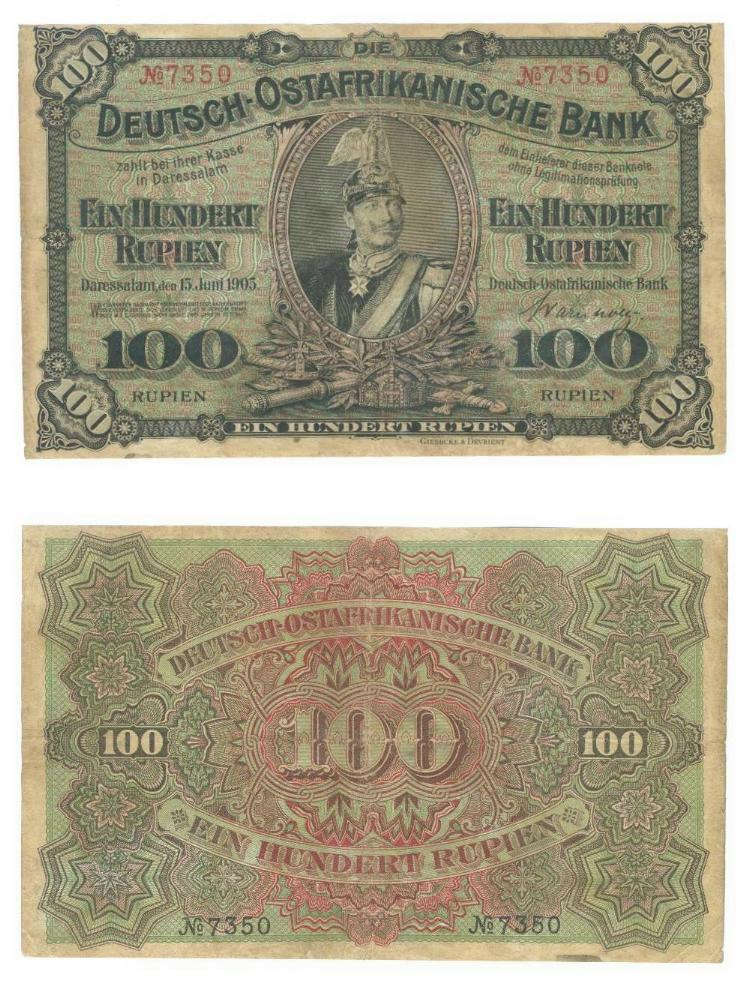
CASE # 0003. Liebe Sammlerfreunde,
die nachstehende Banknote der Deutsch-Ostafrikanischen Bank wurde mir im Januar
2002 auf dem Postwege gestohlen. Falls Du diese Banknote angeboten bekommst oder
Informationen über den Verbleib dieser Banknote hast, sende mir bitte umgehend eine
eMail.
Ist Dir ebenfalls eine Banknote gestohlen worden, sende mir aussagekräftige Daten
(idealerweise ein Bild oder die Seriennummer) dieser Banknote und ich werde die Daten
hier veröffentlichen!
Deutsch-Ost-Afrika
Vorkriegsausgabe der Deutsch-Ostafrikanischen Bank, 100 Rupien vom 15.6.1905,
4-stellige KN
ENGLISH: the following German East Africa 100 Rupien 15.6.1905 (Pick-4) (ser.# 7350)
banknote was lost by Deutsche Post in Germany (in January 2002).
Author: Lifer
Internet Web Pages
Extract Date: April 16 2002
See also
Extract ID: 3793
Posted - April 16 2002 : 20:53:22
--------------------------------------------------------------------------------
1.0 INTRODUCTION:
The East African Newspaper of 4-10 February 2002 carried an article titled "Game Carnage in Tanzania Alarms Kenya", written by John Mbaria with supplement information from Apolinari Tairo of Dar es Salaam. The article was on The Ortello Business Hunting Company, which started to hunt in the Loliondo Game Controlled Area in 1992.
The following are issues raised in the article:
a) Hunting activities carried out in Liliondo Game Controlled Area near the Tanzania / Kenyan border causes loses of 80% of the Kenyan wildlife.
b) Hunting is conducted in the migratory route in the south between Kenya and Serengeti National Park. The animals are hunted during the migratory period as they move to Kenya and on their way back to Tanzania in July to December.
c) Hunting is threatening the Kenyan tourism industry, which earns the country USD 256.0 annually.
d) The Hunting kills animals haphazardly, without proper guidance and monitoring of actual number of animals killed and exported outside the country.
e) Airplanes belonging to Ortello Business Corporation (OBC) carry unspecified type of live animals and birds from Loliondo on their way back to UAE. Further more, the air planes fly directly in and out of Loliondo without stopping at Kilimanjaro International Airport (KIA).
The following are responses to the issues raised:
2.0 Conservation of wildlife in Tanzania
Tanzania is among the top ten countries in the world rich in biodiversity. Tanzania is also leading in wildlife conservation in Africa. It has 12 National Parks, including the famous Serengeti National Park, 34 Game Reserves and 38 Game Controlled Areas. The wildlife –protected areas cover 28% of the land surface area of Tanzania. In recognition of the good conservation works, Tanzania was awarded a conservation medal in 1995 by the Safari Club International whose headquarters is in the United States of America.
Tanzania has a number of important endangered animal species in the world. Such animal species are: Black Rhino, Wild Dog, Chimpanzee, Elephant and Crocodile (Slender Snorted Crocodile).
In 1998, the Government of Tanzania adopted a Wildlife Policy, which gives direction on conservation and advocate sustainable use of wildlife resources for the benefit of the present and future generations.
3.0 Tourist Hunting
Regulated tourist Hunting or any other type of Hunting that observes conservation ethics does not negatively affect wild animal populations. This is because Hunting ethics is based on selective Hunting and not random shooting of animals. Hunting was banned in Tanzania from 1972 to 1978. The resultant effect was increased poaching and reduced government revenue from wildlife conservation. Low revenue caused low budgetary allocations to wildlife conservation activities and the lack of working gear and equipment. When the tourist Hunting resumed Elephant population increased from 44,000 (in 1989) to 45,000 (in 1994). Elephant is a keystone species in the Hunting industry and is a good indicator in showing population status of other animal species in their habitat.
In 1989 to 1993 the government revenue from the Hunting industry increased from USD 2,422,500.00 to USD 7,377,430.00. The government earned a total of USD 9.3 Million from tourist Hunting in the year 2002. Increased revenue and keystone species such as Elephant are the results of efficient implementation of good plans and policies in conservation and sustainable use of wildlife resources.
4.0 Response to the issues raised in the article
4.1 Hunting against the law by OBC
OBC is one of the 40 Hunting companies operating in Tanzania. The Company belongs to the United Arab Emirates (UAE). Different from other Hunting companies, OBC does not conduct tourist Hunting business. The Kingdom of UAE has been the client Hunting in the Loliondo Game Controlled Area since 1992.
In conducting Hunting in Loliondo Game Controlled Area, the Company adhere to the law and regulations governing the tourist Hunting industry, namely:
4.1.1 Payment of concession fee amounting to USD 7,500.00 per Hunting block per year.
4.1.2 Requesting for a Hunting quota from the Director of Wildlife, before issuance of Hunting permit.
4.1.3 Payment of game fees as stipulated by the Government.
4.1.4 Hunting only those animals shown in the Hunting permit.
4.1.5 Contributing to the development of the Hunting block, local communities’ development projects and anti-poaching activities.
The following is what OBC has done so far:
· Contribution towards the development of the Ngorongoro District of USD 46,000.00
· Construction of Waso Primary and Secondary Schools, six bore holes and cattle dips and has purchased two buses to enhance/local transportation. Furthermore, OBC contributed TSh. 30.0M to six villages in the Hunting area, for providing secondary school education to 21 children.
· Purchased a generator and water pump worth TSh. 11.0M for provision of water to six villages. It has also constructed all weather roads and an airstrip within Loliondo area.
4.1.6. Different from the rest of the Hunting companies OBC Hunting period is very short. Normally the Hunting season lasts for six months, but OBC hunts for a maximum of four months. Few animals are shot from the Hunting permit.
4.2 Animals hunted in migratory routes.
The Government of Tanzania has permitted Hunting in the Loliondo Game Controlled Area and not in the migratory route between Masai Mara and Serengeti National Park. The Loliondo Game Controlled Area is a plain bordering the Serengeti National Park to the east.
4.3 The right for Tanzania to use wildlife in the Loliondo Game Controlled Area
The wildlife found in Tanzania is the property of the Government of Tanzania. The notion that these animals belong to Kenya is not correct. The wild animals in Loliondo Game Controlled Area do not have dual citizenship . Since some animal species move back and forth between Tanzania and Kenya it is better understood that these animals would be recognised to belong to either party during the time they are in that particular country. Animals in Masai Mara, Serengeti, Loliondo and Ngorongoro belong to one ecosystem namely, Serengeti ecosystem. However, Tanzania being a sovereign State with her own policies has the right by law to implement them. The same applies to Kenya, which has the right to implement its no-Hunting policy basing on the administration of her laws. Tanzania has therefore, not done anything wrong to undertake Hunting on her territory.
4.4 Hunting is threatening Kenyan tourism
Migratory animals move into Kenya during the rainy season. After the rainy season they move back to Tanzania. Animals that are hunted in Liliondo Game Controlled Area during this time of the year are very few. In the year 2000, only 150 animals were hunted, and in the year 2001 only 139 animals were hunted. It is therefore, not true that 80% of the animals in the border area were hunted. Based on this argument, it is also not true that Hunting conducted by OBC is threatening the Kenyan tourism industry. Tanzania does not allow Hunting of elephants 10 kilometres from the Tanzania/Kenya international boundary. (CITES meeting held at the Secretariat Offices in Geneva in 1993). This is an example of the measures taken to control what was erroneously referred to by the East African Paper as “haphazard Hunting of animals of Kenya”.
Furthermore, it is not true that the Wildlife Division does not know the number of animals that are killed. Control of Hunting is done by the Wildlife Division, District Council and other Law Enforcement agencies. The OBC does not capture and export live animals since it does not possess valid licence to do so.
4.5 OBC airplances export assorted number of live animals from Loliondo to UAE
Capture and export of live animals and birds is conducted in accordance with the Wildlife Conservation Act No. 12 of 1974 and resolutions of the Convention on International Trade of Endangered Species of Wild Fauna and Flora (CITES). The live animal trade is also conducted in accordance with the International Air Transport Association (IATA) regulations, with regard to the size of the boxes/containers allowed to transport specific animal species in order to avoid injuries or death of the same. The principle behind the live animal trade is sustainability. CITES may prohibit exportation of animals whose trade is not sustainable. On these grounds it is obvious that CITES and therefore, its 150 members recognise that the Tanzanian live animal trade is sustainable.
Live animal traders who exports animals, birds and other live specimens are obliged to adhere to the following procedure:
i) Must hold valid licence to trade on live animals.
ii) Must hold a capture permit and thereafter an ownership permit./certificate. The number of animals possessed and the number of animals listed on the ownership permit must be consistent with the number of animals that were listed in the capture permit and actually captured and certified.
iii) Must obtain an export permit for animals listed on the ownership permit/certificate.
iv) The Officer at the point of exit must certify that the animals exported are those listed on the certificate of export. The number of animals to be exported must tally with the number listed on the certificate of export.
Verification of exported animals is conducted in collaboration with the police and customs officials.
v) The plane that will carry live animals is inspected by the Dar es Salaam and Kilimanjaro Handling Companies’ Officials.
vi) For animals listed under CITES, appropriate export and import certificates are used to export the said specimens. If there is any anomaly in exporting CITES species, the importing country notifies CITES Secretariat, which in turn notifies the exporting country, and the animals in question are immediately returned to the country of export.
4.6 Other specific isues
4.6.1 Hunters are given blank permits
Companies are issued Hunting quotas before they commence Hunting activities. Each hunter is given a permit, which shows the animals that he/she is allowed to hunt depending on the quota issued and the type of safari. There are four types of safari Hunting as follows: 7, 14, 16 and 21 days safari. Each Hunting safari indicates species and numbers of animals to be hunted. When an animal is killed or wounded the officer in-charge overseeing Hunting activities signs to certify that the respective animal has been killed. If the animal has been wounded, the animal is tracked down and killed to ensure that no other animal is killed to replace the wounded animal at large. This procedure is a measure of monitoring of animals killed by hunters.
4.6.2 Good Neighbourhood Meetings between Tanzania and Kenya
There are three platforms on which Tanzania and Kenya meet to discuss conservation issues as follows:
a) The Environment and Tourism Committee of the EAC.
b) The Lusaka Agreement. In the Lusaka Agreement Meeting conservation and anti-poaching matters amongst member countries are discussed. The HQ of the Lusaka Agreement is in Nairobi.
c) Neighbourhood meeting. Experts in the contiguous conservation areas meet to discuss areas of cooperation between them, for example, in joint anti-poaching operations. Based on the regulations that govern the Hunting industry animals are not threatened by extinction since the animals that are hunted are old males for the purpose of obtaining good trophies. Trophies are attractions in this Hunting business. It is on this basis that tourist Hunting is not discussed in the said meetings, because is not an issue for both countries.
4.6.3 OBC airplanes flies directly to and from Loliondo without passing through KIA
The Tanzania Air Traffic Law requires that all airplanes land at KIA before they depart to protected areas. When the airplanes are at KIA and DIA the respective authorities conduct their duties according. The same applies when airplanes fly to UAE. They are required to land at KIA in order to go through immigration and customs checks. The allegation that OBC airplane does not land in KIA is therefore false. Furthermore, Tanzania Air Traffic Control regulates all airplanes includingly, OBC airplane at entry points.
4.6.4 OBC sprays salt in some parts of the Loliondo Game Controlled Area in order to attract animals from Serengeti National Park.
These allegations are baseless since the Tourist Hunting Regulations (2000) prohibit distribution of water and salt at the Hunting site in order to attract animals for Hunting. Besides the Game Scouts who supervise Hunting had never reported this episode. Furthermore, there are no reports that OBC is responsible for wild fires that gutters the south of the Serengeti National Park.
4.6.5 Cancellation of OBC block permit in 1999 since it was involved in the exportation of live animals.
This allegation is not true. The truth is that Hunting blocks are allocated to Hunting companies after every five years. The allocation that was done in 1995 expired in 1999. The next allocation was done in year 2000 and the companies will use the allocated blocks until 2004.
4.6.6 The UAE Royal Family contributions to the Wildlife Division
This is true. The Wildlife Division had received support from the UAE including: vehicles, transceivers and field gear in 1996. This was part of the fulfilment of the obligation by all Hunting companies to contribute towards conservation and anti-poaching activities.
Conclusion:
Records in the Ministry of Natural Resources and Tourism show that there is no other District in Tanzania with Hunting area, other than Ngorongoro District, that receives enormous funds from Hunting business for community development. OBC contributes up to TSh. 354,967,000.00 annually for community development in Loliondo.
The Government of Tanzania has no reasons to stop the Hunting activities in Loliondo Game Controlled Area. The government sees that local communities and the Ngorongoro District Council benefit from the Hunting industry.
Edited by - lifer on 04/16/2002 20:57:41
Author: PST Correspondent, Arusha
Internet Web Pages
Extract Date: January 24, 2003
See also
Extract ID: 3903
Several people have been seriously injured following clashes between Masai and Rangi tribes over land at Katikati Village, Kiteto District in Manyara region.
The Arusha Regional Police Commander, James Kombe, said yesterday that the incident occurred on Wednesday when a group of Rangi tribesmen from Isolwa Village in Kondoa district, Dodoma Region armed with clubs, machetes and other traditional weapons attacked four households of the Masai and burned their houses.
The affected Masai cried for help from their colleagues who gathered together within no time clashes ensued that left several people injured.
Police from Kiteto heard about the clashes and rushed to scene to bring the situation to normal.
Kombe said the Masai wanted to use the area for grazing their animals whereas the Rangi want it for crop cultivation, hence the fight.
He said the loss resulting from the burnt out households was estimated to be 4.9m/- and police are holding four persons in connection with the incident.
As a result of the incident, district commissioners of Kiteto and Kondoa would meet to discuss the situation with residents of the area in order to get a solution.
It is the second time that clashes have erupted between pastoralists and farmers in the area. Two years ago, two people were killed in similar clashes.
Author: Ryszard Antolak
Internet Web Pages
Extract Date: Jan 28, 2003
See also
Extract ID: 3800
Last February, while on holiday to East Africa, my wife and I happened to be passing through the the beautiful city of Arusha in Tanzania which, at that time of the year, was awash with bright flowers. I suddenly remembered the stories my mother and grandmother had told me about the Polish resettlement camp at Tengeru, where they had spent several years. It was somewhere near Arusha.
I asked our Tanzanian driver whether he knew anything about a place called Tengeru, or about any Polish camp. Yes indeed, he answered. There was a small district outside Arusha called Tengeru. He would be able to take us there. But knowing nothing about a Polish camp, he stopped at a local police-station to enquire for us. The friendly Tanzanian policeman was very helpful. He knew all about the Polish camp; gave us directions and phoned ahead to prepare for our arrival. The old site of the Polish camp, we learned, now lay within the grounds of a large argricultural college. We needed special permission to enter it.
Turning in from the busy road, we drove down a beautifully tree-lined road in the shadow of Mount Kilimanjaro. The road was narrow and uneven, causing the landrover to bounce up and down. Bananas grew all around us in rich abundance.
Half-way down the lane, a tall elderly Tanzanian in a torn jacket and strange fur-lined hat stood waiting for us. He was to be our guide for the last mile-or-so of our journey. He spoke no English, but told us through our interpreter (the driver) that he could remember the time when the Poles were here in the 1940s.
Finally, we came to halt. The old man took my hand, led me out of the landrover, and pointed into the distance with a long bony finger. Before us was a white circular wall with a metal gate. Three Tanzanian women stood before it with bunches of keys. They welcomed us, unlocked the gates, and we were able to enter.
It was a large cemetery: all that remained of the Polish compound. Near the entrance, a simple stone monument told (in Polish, English and Swahili) that these were the graves of Poles who had died in exile. There were two-or-three hundred headstones within the walls, each one clean and bleached white in the hot African sun. A scattering of broad trees here and there gave some welcome shade.
I walked among the headstones, reading the Polish names and the dates, looking at the Roman and Orthodox crosses, (as well as the few Stars of David) carved clearly upon them. The most recent dated from 1963! All of the stones were beautifully clean. Only a few strands of dried yellow grass grew, here and there, among them. I couldn't discover who tended these graves, but they had been lovingly looked after.
It was a very emotional experience. So many Polish names! So many who had died on foreign African soil without being able to return home! My eyes began to fill with tears. The old man, who all this time had been standing respectively at the gates, came towards me. He, too, had tears in his eyes. He embraced me tightly. He told me that he remembered the Polish inhabitants of the camp with affection. Many times he had gone there with his mother to sell bananas.
"Does anyone ever come here to visit?" I asked him.
"No", he explained through our 'interpreter'. Although we learned that a film crew from Poland had arrived several months earlier to shoot footage for a documentary. Apart from that, no-one came.
"And who looks after the graves?" I enquired.
The old man did not understand, but smiled, showing the gaps in his teeth. He embraced me again. I thanked him warmly and pressed a few dollars into his hand. He smiled, nodded his head. and disappeared.
We took a few photographs and then returned slowly to the landrover, meditating on this often-forgotten episode of buried Polish history. Even surrounded by the lush vegetation and fertile red soil of this part of Tanzania, it was a sad and lonely place.
Ryszard Antolak
Author: Dr Brendan Whyte
Internet Web Pages
Extract Date: 2004
See also
Extract ID: 5545
Undaunted by this [Paraguayan] misadventure, in 1878 Keith managed to secure the leadership of what would be the last R.G.S.-sponsored African expedition, an attempt to discover a viable route for a road from the East African coast inland to the great African lakes. Captain James Frederick Elton, the vice-consul at Zanzibar from 1873, had set out on a similar mission, but had died on the return leg of his expedition to Lake Nyasa in 1877. Keith was to be accompanied by the 21-year-old Joseph Thompson, but the two did not get on, Keith's quiet scientific intelligence exasperated by his companion's gung-ho attitude.
After spending time in Aden, and then several months in Zanzibar outfitting the expedition, Keith and Thompson set off from Dar Es Salaam on 19 May 1879. On 28 June, only 40 days later, and less than 150 km from Dar Es Salaam, Keith was dead from dysentery, leaving the 150-man expedition in the hands of the bewildered 21-year-old Thompson. Thompson, subsequently the first European to traverse Masailand, went on to become an African explorer to rank with Livingstone and Stanley, even though he also died young, at 37. Keith Johnston meanwhile has been almost forgotten.
Author: Dr Brendan Whyte
Internet Web Pages
Extract Date: 2004
See also
Extract ID: 5546
Particularly fascinating is the information on the motivations (and pay rates) of expedition porters, the description of squalid Zanzibar (Livingstone referred to it as 'Stinkibar'), and the contrasts between the various other African explorers of this time, particularly Burton, Livingstone and the alternately feted and hated Stanley: "Damn public opinion--the fellow has done no geography!" (p.64 quoting Markham, Secretary of the R.G.S.). A couple of appendices add further life to the story of the expedition, giving the number and prices of the instruments carried, and a detailed list, again with prices, of Thompson's personal equipment, which included 3 pairs of pyjamas, 6 merino vests, 6 towels and 12 handkerchiefs! A typical entry from Keith's expedition diary is also given, showing his meticulous approach to the need for scientific data and measurement: he notes changes in direction of the 150-man expedition as often as every five minutes!
The book is illustrated with extracts from a few period maps of Africa and East Africa, along with a number of photographs, many taken by the author [James McCarthy] during his days as a surveyor in Tanzania in the 1960s or during his 2001 attempt to locate Keith's grave near Mt Hatambula. There are even some photographs taken by Keith Johnston himself in Africa.
Author: Andrew Leigh
Internet Web Pages
Extract Date: March 05, 2004
See also
Extract ID: 5112
Rhys-Davies used to be a radical leftist, as a university student in the '60s. He first started to come around when he went to the local hall to hear a young local member of parliament by the name of Margaret Thatcher. "I went to heckle her," Rhys-Davies says. "She shot down the first two hecklers in such brilliant fashion that I decided I ought for once to shut up and listen."
It was the beginning of his eventual transformation into a conservative. Rhys-Davies's father was a colonial officer, but from a poor "working-class socialist" background, which Rhys-Davies absorbed into his bloodstream. He spent a large portion of his childhood in Tanzania, where his father was posted.
He says, "As a child, my father showed me a dhow in the harbor at Dar es Salaam and said, 'You see that dhow? Twice a year it comes down from Aden filled with boxes of goods. On the way back up it's got two or three black boys on it. Those boys are slaves. And the U.N. won't let me do a thing about it.'"
Rhys-Davies says that his father predicted our current state of affairs, once telling his son, "The next world war will be between Islam and the West. And it will happen in your lifetime."
Author: The Very Revd Jerry Kramer
Internet Web Pages
Extract Date: 15 April 04
See also
Extract ID: 4720
4-17-04 - A Letter from Africa
(Lifted directly from Kendall's blog http://titusonenine.classicalanglican.net/index.php?p=922)
April 15, 2004
The Most Rev. Frank T. Griswold
Presiding Bishop and Primate
The Episcopal Church
815 Second Avenue
New York, NY 10017-4503
USA
Your Grace,
Easter greetings in the name of our Lord and Saviour Christ Jesus. Stacy and I thank you for your kind letter of April 1, 2004 offering to appoint us as Volunteers for Mission of the Episcopal Church here in Tanzania.
While we are Episcopalians in good standing in the Diocese of Texas, and very much love and respect our dear Bishop Don Wimberly, we cannot accept your offer at this time. When first arriving in Tanzania, we were told in no uncertain terms that we would be asked to leave had we come here affiliated in any way with The Episcopal Church Center. Neither can we represent the ECUSA, in conscience, having denied the truth of scripture and the Church’s traditional beliefs on issues of human sexuality. We categorically reject the consecration of Gene Robinson as an act that is not of God and whose Office we will never recognize.
Our ministry here has been hampered from day one by deep suspicions directed at any one coming in the name "Episcopalian." We can tell you first hand that African Christians feel utterly and brutally betrayed by the Church in America. The consecration of Gene Robinson has caused enormous harm here and emboldened persecution and violence against the Christian Community.
We love you as a Christian brother and pray for you daily. Please do not take this response as an act of malice in any way; we harbour none against you or anyone else who shares a differing opinion on this issue. Our ministry here in Tanzania simply cannot be credible, nor would it be accepted, if affiliated publicly with the ECUSA. In fact it would put us at greater jeopardy than we are at present. Nor can we represent the ECUSA officially because of its sinful actions that are tearing the bonds of our Global Communion. Please keep us in your prayers and be assured of ours.
Sincerely in the Risen Christ,
The Very Revd Jerry Kramer
Rector
Christ Church Cathedral, Arusha
cc: The Rt. Rev. Don Wimberly, Bishop of Texas
The Rt. Rev. Charles E. Jenkins, Bishop of Louisiana
City of Derry Athletics Club
[Picture: Bob Tisdall (253) Wins from "Slats" Hardin (430) of the United States]
Bob Tisdall died on Wednesday [July 28] at his home in Australia.
Malcolm McCausland recalls recalls the amazing story of the man who won gold at the 1932 Olympics in Los Angeles almost exactly 72 years ago.
When Bob Tisdall crossed the finish line in the 400 metres hurdles at the Olympics in Los Angeles almost exactly 72 years ago (1 August 1932) he became only the second man to strike gold in the green of Ireland. It also capped an amazing chapter in the life of one of the country’s greatest and most remarkable athletes.
Tisdall’s victory came as a major surprise - he had only run the 400 metres hurdles three times before arriving in Los Angeles - and he was denied a world record of 51.7 seconds only because he knocked down the final hurdle. Later because of the incident the rules were changed and a few years ago the President of the International Olympic Committee Juan Samaranch presented him with a Waterford Crystal rose bowl with an image showing him knocking over a hurdle.
Robert Morton Newburgh Tisdall was born on the 16 May 1907 in Ceylon, now Sri Lanka. Although born to an Anglo-Irish family Bob, as he was always known, was 100% per cent Irish in his breeding. His father was an All-Ireland sprint champion while his mother was an Irish hockey international and by all accounts a formidable golfer.
Inspired by the acrobats on a visit to circus as a young boy, he developed an interest in physical culture that was to last all his life. For weeks afterwards he spent all his free time doing cartwheels, walking on his hands and using the branches of a tree as a trapeze.
It was in prep school at Mourne Grange, standing in the shadow of Slieve Donard, that he first found a gym which enabled him to develop the skill, balance and poise that was eventually to take him to the winner’s podium in Los Angeles.
After Mourne Grange he went to public school at Shrewsbury where at the age of 14 the fascination for hurdling had already gripped him. After leaving school he went to work in an office in London but after only ten months of city life an x-ray showed he had deposits of soot in his lungs. He was advised to live in the country and it was only then that a university career was considered. But he had no formal qualifications from Shrewsbury which would have gained him entrance and was refused a sports scholarship at Oxford. He worked hard for and passed the entrance exam to Cambridge in 1928.
A very successful athletics career followed and in his final year, 1931, Tisdall was elected CUAC president charged with the responsibility of selecting the team for the annual match against Oxford. He played a captain’s part winning four of the eight individual events – a feat only equalled 60 years later. He could have won a fifth, his strongest event the 220 yards hurdles, but showing his measure as a man he stood down so that a friend would have the opportunity of winning a full-blue.
Early in 1932 he wrote an impassioned letter to the President of the Irish Olympic Council, General Eoin O’Duffy, asking him to be considered to represent Ireland at the Olympics later that year. O’Duffy was so taken by the tone of the letter, he immediately invited the Nenagh man over to run in Ireland’s Olympic Trials at Croke Park. To pursue his Olympic dream, Bob promptly left his job and moved with his wife to Sussex where he lived in a disused railway carriage in an orchard and trained by running around the rows of trees.
Tisdall failed to make qualifying time at the trial but was given another chance by O’Duffy at the Irish Championships, also at Croke Park. This time, he made no mistake winning in a national record of 54.2 seconds, well inside the 55.0 seconds standard. After two weeks at the Irish Olympic training camp at Ballybunion, Co. Kerry, he faced the tortuous 14 day journey to California.
According to contemporary accounts the temperatures crossing the deserts of Nebraska and Colorado had registered in excess of 118°F (53°C). Tisdall whose normal racing weight was 11st 11lb (75kg) lost seven pounds (3.5kg). He had also slept badly during the 14 day journey and was anxious on account of having only raced over the 400 metres hurdles three times previously in his lifetime. In Los Angeles he lost another three pounds and amazed everyone by spending 15 out of every 24 hours in bed. Even more surprisingly, he never put on a running shoe or ran a yard!
Three days before the heats he tried a jog but discovered that the foot injury sustained twelve months previously had recurred on him. Had the Games been held today he would probably have withdrawn but in a less sophisticated era he merely attributed his symptoms to nerves.
Nevertheless, Tisdall opened his account in Los Angeles by winning his preliminary round heat in 54.8 seconds before leading home the competitors in the second semi-final in 52.8 seconds, 1.4 seconds faster than his personal best.
Drawn in lane three, Tisdall seemed to enjoy a narrow advantage over his five rivals in the early part of the final and was well ahead when the field entered the home straight. He was still comfortably clear coming down the home straight but in the dash to the line he brought down the final hurdle making him stumble for five or six strides and allowed the American Hardin to get within a yard of him at the tape.
Tisdall’s time of 51.7 seconds would have been a world record but under the rules at the time was disallowed because of Tisdall bringing down the final hurdle. The Tipperary man did not any waste time celebrating but immediately made for the throwing area. There he encouraged his friend and team mate Dr Pat O’Callaghan who had trailed Finn Ville Porhola for five rounds in the hammer to win a second Irish gold with his last throw of the competition. It completed Ireland’s greatest ever hour in the Olympic Arena winning two gold medals in only the country’s second Olympiad.
Later Bob lived in South Africa, where he ran a gymnasium which he converted to a nightclub in the evening. He moved to Tanzania and grew coffee before raising cattle in Australia. He claimed to have run his last race at the age of 80 and took part in the Sydney Olympics torch relay. He was present in Nenagh in 2002 when a statue was unveiled in memory of him and the town’s two other Olympic champions, John Hayes and Matty McGrath. Last year, he was involved in a serious accident in which he ruptured his spleen as well as breaking his shoulder blade and several ribs after he falling down a steep set of rock stairs. But within a short time he was back on his feet - only minor setback for a man who conquered the world all those years ago.
Internet Web Pages
Extract Date: 31 July 2004
See also
Extract ID: 4727
A PARTY of sixth-formers has been robbed at gunpoint while on a trip to Tanzania, it emerged today.
The nine pupils, from Wheatley Park School in Oxford, had passports, cash and valuables taken by a group of six men on motorcycles who held up a bus travelling in the Arusha National Park. None of the teenagers were hurt during the incident.
They were accompanied by a teacher from the school and a representative from World Challenge, a company which organises expeditions for schools.
The Foreign Office tells travellers heading for Tanzania that "armed crime is increasing" and warns of "isolated but serious attacks involving expatriates and visitors".
John Mitchell, education spokesman for Oxfordshire County Council, today said: "Oxfordshire County Council has confidence that all its schools make judgements about trips abroad with great care.
Fortunately, incidents such as this are extremely rare and, fortunately, nobody was hurt."
The robbery took place on July 31 between the towns of Moshi and Arusha, near Mount Meru, a 15,000ft peak near Mount Kilimanjaro which the party was intending to climb.
The trip was organised by London-based World Challenge, which was behind just under 300 expeditions for around 3000 students from schools across the UK this summer.
Internet Web Pages
Extract Date: August 01, 2004
See also
Extract ID: 4873
The Blog of Death
Robert Morton Newburgh Tisdall, the world's oldest track and field Olympic gold medalist, died in his sleep this week. The exact date of his death was not released. He was 97.
Born in Ceylon to an Anglo-Irish family, Tisdall was a natural athlete who set South African, Canadian and Greek records in the hurdles. While studying at Cambridge University, he wrote an impassioned letter to Gen. Eoin O'Duffy, the president of the Irish Olympic Council, to request an audition for the Irish Olympic Team. His try-out was granted.
Tisdall's first run failed to impress, but during his second attempt, he ran the 400m hurdles in 54.2 seconds and qualified for the 1932 Olympics. He prepared for the competition by leaping over sheep grazing in England's South Downs.
At the Los Angeles Games, Tisdall won the 400m hurdles race in 51.7 seconds and became the second Irishman in history to win a gold medal for his country. He actually broke the world record time in the event, but his accomplishment was not recorded because he knocked over the last hurdle before crossing the finish line. Tisdall also came in eighth place in the decathlon. After his victory, he attended a celebratory dinner and shared a table with pilot Amelia Ear