See also
Read, David Beating about the Bush
Page Number: 143
Extract Date: 1932
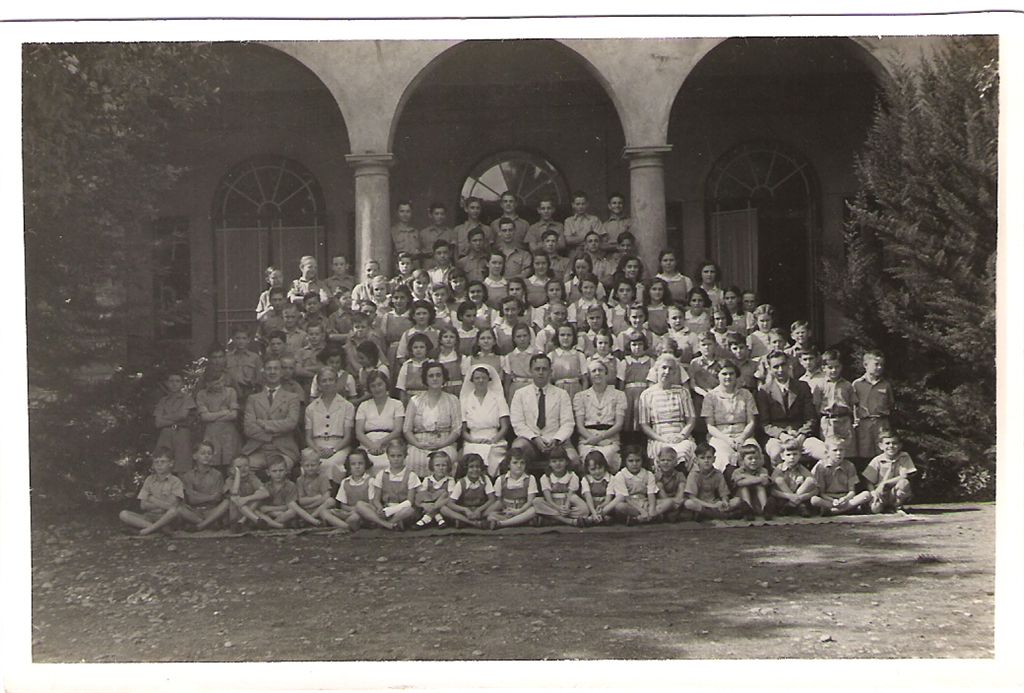
Arusha School

See also Arusha School Alumni
Name ID 28
Nettelbeck, David A history of Arusha School, Tanzania
Page Number: 19
Extract Date: 1928-32
Chambers arrived with 17 new recruits and at a conference in November 1928 the following was recorded: "The conference recommends to the Executive committee that a European school be opened immediately at Ngare Nairobi near Moshi in Mr, Geyer's house by Mr. and Mrs. Boothe, on the condition that, the Government pays the rent of "5 per month, and makes a grant of "50 toward necessary improvements, and that an application be made for a boarding grant for each European child in residence at this school. "
This was a very unspectacular and tentative beginning, but it was a beginning. There were in 1929 19 children living in rough and temporarily converted farm buildings; the area was remote and difficult of access; there was a problem of water supply and at night lions could be heard drinking such water as there was; the Headmaster was issued with a game licence so that he could shoot the school's meat supply and Boothe and his wife were in fact the only staff.
There were other problems too. Some of the fees were not paid., the settlers were unable to finance the scheme on their own and the mission was not prepared to underwrite it from its scanty resources for African work. Boothe apparently proved to be an unsatisfactory person who was unhappy living in such isolation, discontented with his personal allowance, critical of the Bishop and involved heavily in debt, both personally and in the school's finances.
This foray into non-African work was obviously not a success and after one year, the mission withdrew altogether from the school and re-allocated Boothe to a training college for native pastors. Boothe tried to transfer to the Government teaching service in September 1929, but was not accepted. He then resigned from the mission and was employed by the West Kilimanjaro Planters Association who took over the school in. January 1930.
This scheme of management did not work either, and in September 1930 the settlers appealed to the Governor who assumed direct control of the school. Boothe was then employed by the Government on a month to month basis until August 1932 when he was given 8 days notice of retrenchment and repatriated to U.K.
This first attempt had been unsuccessful and had left both the Government and the Mission in an embarrassing position. The school struggled on with men called Stowell and Feelie as Headmasters between 1931 and 1933. It is not clear from the records just when Boothe left the school or whether the other two men had successive or joint responsibility. (See Appendix N.)
See also
Hamshere, Cyril Articles on a European Primary School and other subjects in Tanganyika, 1940's
Page Number: 1b
Extract Date: 1928
The first pupils were transferred from an earlier school opened in 1928 at Ngare Nairobi on the plains on the North-West foot of Kilimanjaro, where wild animals grazed up to the edge of the school compound and the Headmaster was expected to provide most of the school's meat by the use of his rifle.
Ulyate Family Personal Communications
Extract Author: Bob Walker
Page Number: 504n
Extract Date: 1930-1950's
Malham Ulyate, Early 1930.s 1935 Awarded "Victor Ladorum" for sporting achievements, Name still on the sports plaque in the dinning hall
Edward Ulyate,(Ted) Early 1930,s 1935 Awarded "Victor Ladorum" for sporting achievements. Name still on the sports plaque in the dinning hall.
Robert Walker (Christopher) 1944-49.
Nigel Borissow 1950,s
Jocelyn Borissow 1950,s
Marjorie Borissow 1950,s
Michael Borissow 1950,s
Donald Ulyate 1950,s
June Ulyate 1950,s
Brenda Ulyate 1950,s
Mrs. Kay Ulyate (Matron) 1950,s
Robin Ulyate 1950,s
Phyllis Ulyate 1950,s
Sally Ulyate 1950,s
Valarie Ulyate 1950,s
Brian Ulyate 1950,s
David Ulyate 1950,s
(Not a complete list)
Elizabeth Van Staden (Ulyate) Lolly wrote saying "I would like to be named as another ULYATE who attended Arusha School 1963 - 1968."
See also
Johnston, Erika The other side of Kilimanjaro
Page Number: 025
Extract Date: 1930's
When I came to live at Ol Molog I had completed a full circle, for I was born on a farm twelve miles away. As there was an age gap of eight years between my nearest sister and I, and as my three sisters (my brother had died of pneumonia) all left home rather prematurely, I spent a good deal of my early childhood depending on African children for companionship. At one stage my only friend was a chimpanzee.
An European school was started in Arusha, and when the headmaster once lunched with my parents he was appalled to discover that I had only an ape as a companion, and he persuaded them to send me to his school. I went as a boarder at the tender age of four and a half; the only advantage of which that I could see was that thereafter I was always below the class average age and therefore considered rather bright!
I can't work out from the book when Erika was born. Aursha School openeed in Arusha in 1934 (although David Read has a photo of it dated 1932). So I'm guessing she was born in the late 1920's.
Nettelbeck, David A history of Arusha School, Tanzania
Page Number: 76
(for full details of this section click on the link on the right, and search for the appropriate page.)
Nettelbeck, David A history of Arusha School, Tanzania
Page Number: 75
(for full details of this section click on the link on the right, and search for the appropriate page.)
See also
Read, David Beating about the Bush
Page Number: 143
Extract Date: 1932
See also
Nettelbeck, David A history of Arusha School, Tanzania
Page Number: 23b
Agreements dated 26th January 1933 and 19th November 1936 (see Appendixes A and B) were signed between the Government of Tanganyika and the Diocese of Central Tanganyika. Under the terms of the agreements, the Government agreed to build and equip the school, maintain the buildings and pay staff salaries at mission rates. The Bishop would be Warden of the school with overall responsibility for its administration and welfare, and appoint the Headmaster and staff.
See also
Hamshere, Cyril Articles on a European Primary School and other subjects in Tanganyika, 1940's
Page Number: 1a
Extract Date: 1934
Arusha [school], on the other hand, was founded in 1934 in buildings provided by the Bishop of Central Tanganyika. This was in keeping with the Government's policy of running most of the Territory's education through 'Voluntary Agencies' i.e. Missionary Societies.
Nettelbeck, David A history of Arusha School, Tanzania
Page Number: 73
(for full details of this section click on the link on the right, and search for the appropriate page.)
See also
Nettelbeck, David A history of Arusha School, Tanzania
Page Number: 20
A mission conference in 1929 expressed the hope that the Government of Tanganyika will adopt the same policy of cooperation with Missions with regard to European education as it does in regard to African education.
Various consultations were going on as to the need, type and best place for a now school. In 1931, there were 58 European children. in Northern Tanganyika receiving no schooling beyond private tuition at home, and the annual report stated the Government 's intention to build a new European school at Arusha in the Northern Province. In order to work this school as economically as possible, it was hoped to complete an arrangement with the Bishop of Central Tanganyika under which he would conduct the school as an agent for the Government. The staff appointed would be subject to the approval of the Government and. the working and management of the school would be under Government inspection.
It is apparent that after the abortive attempt in 1928, and with the stringency of the depression, plans were much more carefully laid. It was not until 1932 that the Governor, Sir Stewart Symes approached Bishop Chambers with a definite offer to build a "first class and modern school and equip it", if the Bishop would find the staff and manage it .
There is no doubt that this "new era of cooperation" between church and state was partly motivated by the shortage of Government funds; the mission teachers were paid approximately one fifth of the government rate.
The Headmaster Wynn Jones saw it more positively. He wrote, "The efficiency, finance and stability of a Government school has so often lacked the personal element and spiritual contact which is so necessary a part of all true education". The Bishop wrote in a quarterly letter, "It is essential that we should give Christian education to European children in this territory for they will be the future leaders. The white man cannot help being a leader here. The African imitates him in all he does and if we can inculcate the ideals of Christ in the lives of our white children, then Christian civilization is much more likely to come to this land". The Greek community promised support and the Bishop continued, "I hope the school will be a little commonwealth of nations including German, Dutch, and Greek children. If the boys and girls of these various communities learn to live, work and play together in school life, they will all the better be able to inform a united community in the future, having the welfare of all at heart and the spirit of esprit d'corps a reality among them!"
The Bishop also hoped that the school would bring the church into contact with Europeans in the territory and hopefully win sympathy from them in missionary work.
So at the request of the Government, Rev. William Wynn Jones was seconded from the mission, sent on early overseas leave and, having newly married, he moved in 1933 to the Ngare Nairobi school to prepare the nucleus there for the move to Arusha. Miss Martha Vance a missionary nurse was also sent on early leave, to return as Matron.
On 22nd May 1934, with Miss Vance as matron and Wynn Jones as Headmaster, the Arusha School opened in its "palatial buildings". It had been designed for 48 boarders, 24 girls and 24 boys, and 30 day pupils. It opened with 33 boarders, and by the end of the year the enrolment had risen to 41 plus 6 day pupils. (See Appendix F.)
See also
McFarland, Alan Photos of Arusha School
Page Number: 01
Extract Date: 1936

See also
Read, David Beating about the Bush
Page Number: 010
Extract Date: 1936
We moved from the farm at Loliondo to the Lupa Goldfield in time for Christmas 1936 and upon arrival, my step-father took one look at the rags my mother and I wore and drove us straight to Mbeya to get us decently clad. After the deprivations of the past year it was overwhelming to be comfortable again, although the comfort was relative and of a primitive sort-we could now buy tea and sugar and have less than threadbare clothes. There were further aspects of our new life that we had not considered whilst at Loliondo. I was now fourteen years old, just over six feet tall, but had only completed less than a year's schooling in my life. Thus, it was decided that I should go to the new Christian Missionary Society (CMS) School at Arusha, in Northern Tanganyika, over 730 miles away along one of the most rudimentary roads in the country. I thought life was suddenly rather exciting, although I had strong reservations about the need for further education.
See also
McFarland, Alan Photos of Arusha School
Page Number: 02
Extract Date: 1936

See also
McFarland, Alan Photos of Arusha School
Page Number: 03
Extract Date: 1936

See also
McFarland, Alan Photos of Arusha School
Page Number: 04
Extract Date: 1936

See also
McFarland, Alan Photos of Arusha School
Page Number: 05
Extract Date: 1936

See also
McFarland, Alan Photos of Arusha School
Page Number: 06
Extract Date: 1936

See also
Nettelbeck, David A history of Arusha School, Tanzania
Page Number: 23b
Agreements dated 26th January 1933 and 19th November 1936 (see Appendixes A and B) were signed between the Government of Tanganyika and the Diocese of Central Tanganyika. Under the terms of the agreements, the Government agreed to build and equip the school, maintain the buildings and pay staff salaries at mission rates. The Bishop would be Warden of the school with overall responsibility for its administration and welfare, and appoint the Headmaster and staff.
Read, David Beating about the Bush
Page Number: 015
Extract Date: 1937 December
My journeys to and from school always seemed to be such adventures that I remember more of the travelling to school than I do of the term-time. Sometimes it was impossible to return home for Christmas as this holiday was at the height of the short rains and the fairly primitive mud roads would be impassable. After my first full year at school in 1937 the roads were thought to be acceptable and we embarked, as usual, on the school bus for Dodoma, with one of the teachers as escort, to spend Christmas with our families. Although the rains had not been heavy, the roads were a morass of mud and potholes and we got as far as Pienaar Heights, about 135 miles from Arusha, before our troubles started. The bus was too heavy, the road too steep, and the mud too slippery for an easy ascent. The bigger boys had to get out and cut brushwood to lay along the wheel tracks and then they had to push while the older girls had to walk. The mud was thick and slimy and clogged our shoes, which made walking and pushing very difficult whilst the road was too narrow for the bus to turn round. With no options to go back or to reverse down the hill, we had to persevere with this Sisyphean task until we reached the top of the hill, pushing in the dark and driving rain with our clothes soaked before we were even half-way on the first leg of our journey. To me the activities of the day had been fun and rewarding, and while most of the others, and the teachers, complained about their cold and soggy state, David How-Brown, Jeff Hollyer and I felt we had had a most worthwhile time. We hoped eagerly that calamities would continue to occur, so as to relieve the boredom of the long and uncomfortable trip with a little adventure. It was on that day, while we were covered in mud, pushing the big bus with all our strength, shouting instructions to the driver, falling flat on our faces in the wet, trying to avoid the spraying mud of the wheels that spun and failed to grip, that a lasting friendship between the three of us was, if you will excuse the pun, cemented.
It was four in the morning by the time we reached Dodoma, and everyone had missed their connecting trains. Those who were going east, like Jeff and David, were told that they could travel on the early morning goods train going to Morogoro, but would have to sit in the Guards van, which delighted them and those travelling to the Lakes would go on at ten the next morning. Only three rooms had been booked at the Railway Hotel for the teacher and those of us going south, and these were given to the girls and small boys, leaving the rest of us to sleep in the hotel lounge. Our companions for the night were a motley crew of sleeping drunkards who had been unable to get home. Our coming in had disturbed them and, waiting until the teacher had gone to bed, they started their party all over again, plying us youngsters with drink. We thought this was a great adventure until daylight came when we had to face our escort, Miss Read.
Read, David Beating about the Bush
Page Number: 023
Extract Date: 1938
For some time tunnelling in the school grounds from the river bank had been carried out by a group of five senior boys. When several of these left the school, interest waned and the tunnels were neglected, but during my second year the Tunnelling Committee decided to revive the work. They invited three new members to join them and to my surprise I was amongst them. I was given a long lecture on secrecy and hard work but when I asked what the tunnels were for, no one seemed to know. They just thought it was good idea and would be first class for midnight feasts, although it is worth considering that at the time any explanation would have satisfied me such was my pride to have been included in the secret mission. When I was younger I had experienced acute claustrophobia when I first wriggled down a porcupine hole and I must admit I did not look forward to digging in a confined space but after a few days I grew accustomed to it. At the end of the first week we had cleared all the fallen debris and boxed in the soft sides.
We were ready to start on new ground and very soon came across hard, impacted soil, which was tough-going. Sweating as we worked we realised there was a shortage of fresh air, so a small chimney was opened which also let in some light but this part of the tunnel then collapsed and had to be cleared, leaving us with a large space, which we named our feasting room. At about this time we discovered there was another party tunnelling away a little above and across our front. Jeff and I had just finished our stint at the face and were in the wash-house when Charlie ran in to say we must go back to the tunnel as there had been an earth fall and two fellows were trapped inside. It alarmed us to realise that the ventilating hole was on the wrong side of the collapse and we fought down our fear as we ran for the river.
The quickest way to rescue the trapped pair would be through the rival tunnel but we could not waste time searching for the other team to seek their permission, so we clambered straight into their tunnel, Charlie leading the way with a torch. The narrow entrance led into a large cave and, in the light of our torch, eight very surprised faces caught in the middle of a feast turned to glare at us. There were two girls and six boys in the party and had there been room for manoeuvre they would have certainly have roughed us up, but as soon as they heard the reason for our invasion, their hostility was forgotten and they set about helping us. Fortunately the collapse had been from the surface, allowing some air to reach the trapped boys, but the tunnel was too narrow to turn round in and all they could hope to do was to move backwards. When they found they could go no further, they panicked and it was with great relief that we were able to clear away the small amount of earth which separated the two tunnels and get them to safety.
Shocked by this near-tragic experience, we gathered outside in the bright sunlight with ashen faces and agreed a temporary halt to our excavations. Inevitably the story leaked out and we were thoroughly cross-examined by the headmaster and the parents of the two girls, although it should be mentioned that it was established that the girls were there only for the feast and not for any scandalous reason. We were told to attend the headmaster's study the next morning before assembly and that we should be prepared to be sent home for good. However, in the event, the morning brought us three strokes of the cane from Mr. Wynne-Jones' practised hand and the girls were sent home for the rest of the term.
See also
Read, David Beating about the Bush
Page Number: 030
Extract Date: 1938
We arrived back at school from this trip a few days before term was to begin, just in time for preparations for the annual attempt on Mount Meru. Mount Meru is a spectacular fifteen thousand foot mountain that would be famous were it anywhere else, but is overshadowed both in height and in reputation by its more famous cousin, Kilimanjaro, across the steppe. It looms over the town ofArusha, nestled in its foothills, and is such an important part of town life, providing the water and climactic conditions that make the town so habitable, that few people who live there have not considered climbing it. This was an annual event and boys over the age of fifteen were, with their parents' consent, allowed to make the attempt. I had taken part in the previous year's climb from the west, but at 13,500 feet many of the boys had dropped back, unable to make it, and the exercise was aborted.
This year there was to be no repetition of that and the mountain would be attempted from the south. It would be heavy going through the bamboo forest, but after that there was a solid rock ridge without the volcanic ash surface which was so tiring and frustrating when approached from the west. The western flank rises in great steps, one step up and then a flat open glade, followed by another climb through thick well-watered forest, then another open glade, with more forest, up to the edge of the volcanic ash at about 12,000 feet. From that height to the top the surface consists entirely of loose ash, making the climb a slippery and exhausting business. On the northern and eastern sides is the huge crater, encircled by 2000 ft high sheer cliff walls and a primeval floor of cedar forest. Strangely-shaped, wizened trees are festooned with Old Man's Beard and the core of the volcano itself rises from the floor of the crater in a grey, grim cone. It makes for an almost primeval atmosphere that is a far cry from the arid steppe to the south.
We found the climb up the steep southern face hard going, with the first part through cedar and loliondo forest. We reached the bamboo belt at about 8,000 feet and it was so thick that the only way to walk through it was to follow the winding game tracks, which were difficult to negotiate and required constant attention to avoid meeting the rhino, elephant and buffalo that also used them. We slept that night at a point just above the bamboo in a well-protected gully near a beautiful spring of clear mountain water, where it became clear that some of the boys had found the climb very demanding and Jeff and I were quite sure that before long the expedition would be turned back. We thought the party far too large, convinced that someone would feel the altitude and become mountain sick, which would necessitate bringing the whole party back. We decided that on the following day, we would make our way to the front of the party and just keep going until we reached the top, even if the rest of them went back. We knew we would get into serious trouble when we arrived back at school, but we were determined to see our names on the "Conquered Meru" Board in the school hall.
On the second morning we left at first light and in about three hours we were well out of sight of the others, so we had a short rest before continuing, until after a breathless two hours, we reached the summit, with sweeping views across to Kilimanjaro and Kenya. We signed the book, had a quick look at this privileged perspective on Africa) before sliding and stumbling back down, catching the rest of the party, already on a return journey, an hour and a half later. Several of the boys were nursing sore stomachs as they had been eating ice for reasons best known to themselves. We thought this state of affairs completely justified our dash to the top, and when Dickie, the master in charge, asked us where we had been, we were quite honest and told him we had reached the summit. He told us he would speak to us when we got back to school, but said that as no one had witnessed our achievement, we could not be listed on the Board until one of the masters had been up and verified the book. We heard no more about it until a week later when our names were called out at Assembly and in a few days the Board shone with its new additions. We felt very pleased and proud of ourselves.
See also
McFarland, Alan Photos of Arusha School
Page Number: 07
Extract Date: 1938/9

Read, David Beating about the Bush
Page Number: 041
Extract Date: 1939
Eventually I had to return to school, but things were a little different than before. During my third (and last) year at school in 1939, when I was in the senior form, tension between the Germans and other European nationals in Tanganyika was running high. These feelings filtered down to the schools too, particularly between the German school at Oldeani and ours, which was English, at Arusha. As the inter-school sports were due at the end of the term, it was decided to organise a half-term camping safari for the twelve oldest boys in each school, in the hopes of paving the way towards a friendlier entente on Sports Day. Mr. Wynne-Jones had instigated the safari and had gone to considerable pains to make it a success but unfortunately, he did not take into account the affects of European politics and group rivalries on the minds of boys. On our arrival at Ngorongoro, it was found that the so-called "boys" from Oldeani were mostly between seventeen and nineteen years old and appeared to be fully trained soldiers. The only games they would play were military ones, which were all they knew, and they spent a great deal of their time attending politicised lectures in German, doing military exercises and parading. We were told to try and co-operate with them, but when they taunted us by saying that soon Germany would take back Tanganyika and kick us all out, we inevitably resorted to fisticuffs. It was a miserable weekend, with our having to listen to insults and pretending to fraternise with them, in the name of international harmony.
The only thing the trip did was to increase our determination to beat the Oldeani School when Sports Day came around, a victory we were to achieve very well. The Greek school also took part and, in fact, the German school earned the lowest marks, with Arusha a contented second, behind the Olympian efforts of the Greeks. A special song had been composed, honouring all three countries, and this was supposed to be sung at the end of the three-day event and initially, the Germans refused to join in, only reluctantly doing so after a lot of persuasion and a few threats. The whole affair opened the eyes of the authorities to the covert politicisation that was going on at Oldeani under the guise of education.
McFarland, Alan Photos of Arusha School
Page Number: 08
Extract Date: 1939
Nettelbeck, David A history of Arusha School, Tanzania
Page Number: 26
Extract Date: 1934-64
To what extent does a headmaster leave his mark upon a school? In the case of the first two heads of Arusha School, who served the school for over 28 years between them from 1934 - 1964, the influence was considerable and each left his own indelible impression on the structure, organisation and ethos of the place.
It must be said right at the outset that Wynn Jones did not have outstanding gifts of organisation or administration. Also in the years 1940 - 42 he had been already nominated Assistant Bishop of the Diocese, there was a chronic staff shortage in the early years of the war when enrolments increased because many children could not return to Europe, and he was part time chaplain to the forces as well as Headmaster of the school. It is little wonder then that Lace found the school not well organised, only fair academically, and sloppy in discipline. In true military fashion he introduced daily physical education and tightened up the rules.
However, those who knew Wynn Jones comment universally on his gifts of leadership, personal magnetism and outstanding empathy with people.
The original school building, with 2 internal quadrangles, enclosed under one roof quarters for all staff, boys' and girls' dormitories, classrooms, kitchen and dining room with the headmaster's home on the first floor. It was quite literally a family unit with staff having all meals with the pupils, and the school kitchen even remaining open through the holidays for the teachers.
At a time when the British community had little social intercourse with European aliens, let alone Africans, Wynn Jones' home was open to all. There was a time during the war when some British residents reported him to the Governor as being anti-British, because he gave a bed to some passing German and Greek travellers.
Many of the pupils said, "He loved us like one of his own children", and stories abound about how he welded the school together as a family. One notable story comes from the day war was declared, He called an assembly of the school and while the children were moving in selected, apparently at random, the German children to retrieve his hat from the far side of the playing field. While they were away, he talked to the others, announced the declaration of war and said, "Here at Arusha School we have always been a family; we don't know what will happen in the future or what will become of our houses and families, but here, we are a family still and will treat each other that way".
His role as a loving, gentle man and a reconciler may be seen in the bridge-building he attempted between the communities. For example between 1934 and 1939 he organised an annual conference of teachers from the European schools in the Northern province. The conference was informal with no official status, but teachers from Arusha School, the 2 Greek Schools, 4 Dutch schools and. 2 German schools met together to read papers and discuss their problems.
He also organised and hosted an annual athletics competition between these schools. In 1937 he led a combined camp in Ngorongoro Crater for the Arusha School Scout Troup and the Hitler Youth Movement from the Oldeani German School. He wrote in the school log. "This was a genuine effort to bring the boys of different nationalities together and to stem what was becoming a very tense position in Northern Tanganyika. The Governor was in every way enthusiastic about the move". Inter-community contacts continued during the war and included children from the Polish school for refugees newly settled near Arusha.
See also
Nettelbeck, David A history of Arusha School, Tanzania
Page Number: 32
A new boarding block had been opened in 1939. The next building in 1949 was a lavish sanatorium with accommodation for 16 sick children, 4 isolation rooms, large outpatient treatment facilities and a nurse's flat. A temporary branch school in the former German School premises 100 miles away at Oldeani was opened in 1950 and remained open for two years; and in 1951 a new junior block came into use at the school. It included dormitories for 48, 4 staff flats, 3 classrooms, a common room, a kitchen, and a hall seating, up to 400 people. A new kitchen in the original school building was opened in 1954. Riddy and Tait described it as "exceptionally well planned", and it held in its basement a large maintenance workshop, handicraft room and stores. The graph in appendix F shows the rapid increase in enrolments in the early 19508 with a levelling out, but a gradual increase in the number of day pupils as Arusha town grew in the late 1950s.
After 1946, all staff salaries were paid from Dar es Salaam, all school accounts were paid from a Government vote by the local Revenue Office and fees were receipted with an exchequer receipt and paid into the Revenue Office.
The educational problems of the school were much the same as they had been in the 1930: and 1940s. Riddy and Tait summarized them as the lack of a clearly drawn. line of demarcation between the primary and secondary stages, a shortage of staff with specialised knowledge and experience, the dislocation caused by boarders who came without previous schooling, the wide range of ability in the command of English and the number of examinations for which students presented themselves: at best these had to be borne in mind by the teachers, and at worst they dictated the pattern of education which the school gave. On the other hand, Riddy and Tait commended a favourable staff-student ratio, the devotion of the staff, the interest which the European Education Authority and the parents;' took in the school, a full and happy boarding life and excellent facilities, with buildings and playing fields of which any preparatory school in the United Kingdom might well be proud!
See also
McFarland, Alan Photos of Arusha School
Page Number: 09
Extract Date: 1940~

See also
McFarland, Alan Photos of Arusha School
Page Number: 10
Extract Date: 1940~

See also
McFarland, Alan Photos of Arusha School
Page Number: 99
Extract Date: 1940~

See also
McFarland, Alan Photos of Arusha School
Page Number: 99
Extract Date: 1940~

See also
McFarland, Alan Photos of Arusha School
Page Number: 99
Extract Date: 1940~

See also
McFarland, Alan Photos of Arusha School
Page Number: 99
Extract Date: 1940~

See also
McFarland, Alan Photos of Arusha School
Page Number: 99
Extract Date: 1940~

See also
McFarland, Alan Photos of Arusha School
Page Number: 99
Extract Date: 1940~

See also
McFarland, Alan Photos of Arusha School
Page Number: 99
Extract Date: 1940~

See also
McFarland, Alan Photos of Arusha School
Page Number: 99
Extract Date: 1940~

See also
McFarland, Alan Photos of Arusha School
Page Number: 99
Extract Date: 1940~

See also
McFarland, Alan Photos of Arusha School
Page Number: 99
Extract Date: 1940~

See also
McFarland, Alan Photos of Arusha School
Page Number: 12
Extract Date: 1942

See also
McFarland, Alan Photos of Arusha School
Page Number: 13
Extract Date: 1942

See also
McFarland, Alan Photos of Arusha School
Page Number: 14
Extract Date: 1943

Evdemon, Mark Personal communication
Page Number: 4b
Extract Date: 1941---1951
I had a younger sister in school. Unfortunately she died there from malarial fever. That was a big blow and within a couple of months I was transferred to the English grade school in Arusha, some 50 miles away. That was around 1943. I did not know much English, just good morning and good night and relied on some Swahili words for a while. Then I started speaking English as best I could and of course I was made plenty of fun of by many kids. That led to several "fights" but that is how growing up in our schools was. Plenty of competition and scraps. Life in the English school became quite good and interesting. They started me off in 3rd grade but was dropped back to 2nd for a spell until I was able to communicate after a few weeks.
Most of the kids were English with a mixture of Greeks, South Africans, Germans, Italians and Polish (refugees from the war). Again, home was a long way away and we lived in dormitories for 3 months and went home for one month. We would get on the train and travel 2 days between home and school. Others lived even further and it would take them 4 to 5 days of train and bus travel. The school was about 3 miles from the train station and when we arrived, they woud line us up and walk us to the school.Our lugguage was brought up by truck.
We were assigned dormitories according to age groups. Some weekends we boarded busses (more like cattle trucks) and they would take us on what they called Picnics. That was a lot of fun. One time they announced on the public address system that they needed some volunteers for clean up duty. I and 3 others volunteered. They took us in a pickup truck to Ngorongoro Crater, some 50 miles away. This is supposed to be the largest crater in the world and is featured quite often on Television travelogs. Many animals live in the crater year round.
Another time, we were asked to get an OK from our parents for mountain climbing. I got the OK. There were about 12 boys and 3 girls in the group and we were bussed to a base camp on the slopes of Mt Meru. This is the 2nd highest moutain in Tanzania, at approximately 14,764 feet high. About 3 in the morning we took off through the forest on our way to climb the mountain. We had an "Askari" (Swahili for soldier); he was to protect us with his gun from encounters with wild animals. Fortunately both there and back we only met up with wild boar and heard lions roar in the distance. Half way up most of the climbers stopped due to fatigue and other problems. 4 boys and a teacher made it to the top. It was very cold and there were several small glaciers up there. We signed our names in a book that was inside a small stone hut and rested awhile, enjoying the vistas.When the clouds obscured the views, we started on our return trip and met the stragglers as we descended the mountain. We finally reached our base camp about 2 AM and went to sleep. When we returned to school, they entered our names on a large plaque that was in the dining area, joining some other names that had preceeded us on the Mt. Meru climbs.
Start of 1950 I left the grade school and went to the only high school in the area; it was in another country, Kenya. . . .
Evdemon, Mark Personal communication
Extract Author: Mark Evdemon
Extract Date: 11 July 2003
Very interesting site, specially as I attended the School for about 4 years (1945-1949); about the Meru mountain climbers...my name was up on a board in the dining area at the time. Do you perhaps have a photo of that board?
Amazing to read about the Giant tortoise. I remember it well.
Mark
Thanks for your feedback and comments.
I don't think I have a photo of "your board", but as you will see from http://www.ntz.info/gen/b00688.html#04062 there are lots of boards still hanging. The one board I took a picture of related to the time I was there (1953-57).
I was back in Arusha last month and visited the school again - and yes the boards are still there, as is the tortoise. Unfortunately I did not have my camera with me, but next time I will try to make sure that I do, and maybe to capture all the boards. I did make a note of all the headmaster names (N.E Langford-Smith 1945-46, C.E.Hamshere 1946-63), and met the current head, and was shown round by one of the teachers. The same buildings as existed in our time, now house 1300 pupils. They still use the same crest/badge, and the motto "Seeking the Highest" has been added. (I'm not sure when, maybe it's always been the school motto). One teacher was very keen to emphasise that they try to teach and live by that motto. And literally - they still have the annual Meru climb.
Good to hear from you. May I have your permission to add your name and comments to the web site. I don't publish email addresses on the web, but happily put people in touch if so requested. If you have any interesting memories, photos or cuttings from your time in Arusha I'm sure there are many who would be interested in sharing them.
Hello David...thanks for your informative e-mail and the interesting Tanzania site that you made. I will be surfing through it again as I am not done checking it all yet. Sure, you can use my name, etc. as you see fit. I am sending you the below address of a site that I made last year so that when I am gone, my children will have a short "history" of my life.
http://www.angelfire.com/pa5/markpa/
See also
Hamshere, Cyril Articles on a European Primary School and other subjects in Tanganyika, 1940's
Page Number: 1
Extract Date: 1 Jan 1946
From January 1st 1946, by mutual agreement, Government had taken over the running of the School from the Diocese, but in recognition of his past services the Bishop was constituted Warden of the School with the right of approving appointments to the staff. He was appointed Chairman of the School Advisory Council and a Chaplain-Master was appointed to the staff, an unusual provision in a Governent School, but one which was never queried for the simple reason that the succession of men appointed proved themselves of indispensible benefit to the school.
See also
Hamshere, Cyril Articles on a European Primary School and other subjects in Tanganyika, 1940's
Page Number: 1
Extract Date: 1946
I [Cyril Hamshere] arrived as headmaster in 1946
See also
Tanganyika Guide
Page Number: 146
Extract Date: 1948
Managed by the Government. Fees, including tuition and board, "64 10s. Per annum. Situate in Northern Province on Tanga-Arusha Railway. Height 4,500 ft. Reduced fees for second and third children.
See also
MacMillan, Mona Introducing East Africa
At the top [of the rift] there is more emptiness until one comes equally unexpectedly on the outlying wheat fields of the Oldeani settlement. The little group of European farms was originally German - most of the present farmers took over enemy property as a going concern after the latest war, and with prices high have been doing well ever since without as much effort as is normally required of the settler. Their wheat maize and barley looked fine, and on the high lip of the Ngorongoro Crater, which we only saw from a distance, they grow coffee. They are administered from Mbulu about thirty miles to the south, and it would seem that up to the present they are rather an anarchical group having achieved little or no sense of community. According to their overlord, the D.C. of Mbulu, they had little good to say of each other when he visited them; there wives were kept busy embellishing their houses with the rich proceeds of each years crop, also a clubhouse was in the process of being built, and the German school was being used by one form of the overcrowded Arusha European boarding-school.
See also
Ulyate Family Personal Communications
Extract Author: Marjorie Borissow
Page Number: 102
Extract Date: 1950's

Sorry the photos of the school are not too good. Colour has faded. Bryn Jones is the man sitting down, on mount Meru also in the fancy dress photo. Remember those! The 2 sitting at the top were one of the teachers. I will try and track down my autograph book and then I will be able to tell you some of the names of the teachers at that time. Mrs Bennett was the art teacher I think.
See also
Ulyate Family Personal Communications
Extract Author: Marjorie Borissow
Page Number: 103
Extract Date: 1950's

Sorry the photos of the school are not too good. Colour has faded. Bryn Jones is the man sitting down, on mount Meru also in the fancy dress photo. Remember those! The 2 sitting at the top were one of the teachers. I will try and track down my autograph book and then I will be able to tell you some of the names of the teachers at that time. Mrs Bennett was the art teacher I think.
See also
Ulyate Family Personal Communications
Extract Author: Marjorie Borissow
Page Number: 104
Extract Date: 1950's

Sorry the photos of the school are not too good. Colour has faded. Bryn Jones is the man sitting down, on mount Meru also in the fancy dress photo. Remember those! The 2 sitting at the top were one of the teachers. I will try and track down my autograph book and then I will be able to tell you some of the names of the teachers at that time. Mrs Bennett was the art teacher I think.
See also
Ulyate Family Personal Communications
Extract Author: Marjorie Borissow
Page Number: 105
Extract Date: 1950's

Sorry the photos of the school are not too good. Colour has faded. Bryn Jones is the man sitting down, on mount Meru also in the fancy dress photo. Remember those! The 2 sitting at the top were one of the teachers. I will try and track down my autograph book and then I will be able to tell you some of the names of the teachers at that time. Mrs Bennett was the art teacher I think.
See also
Ulyate Family Personal Communications
Extract Author: Marjorie Borissow
Page Number: 106
Extract Date: 1950's

Sorry the photos of the school are not too good. Colour has faded. Bryn Jones is the man sitting down, on mount Meru also in the fancy dress photo. Remember those! The 2 sitting at the top were one of the teachers. I wil try and track down my autograph book and then I will be able to tell you some of the names of the teachers at that time. Mrs Bennett was the art teacher I think.
See also
Nettelbeck, David A history of Arusha School, Tanzania
Page Number: 36
In 1951 there had been criticism in the press about the standard of teaching at the school. The Headmaster answered this by explaining to the School Council that children from non English speaking homes had an undoubted effect upon the standard of education in the school, especially when the children themselves were unable to speak English when admitted. He followed this up 3 months later by repeating, "much has been done to allay ideas that the standard of education at this school is lower than it should be", though this comment does not seem to have satisfied the members of the School Council, who complained to the Director later that year (see above.)
Hamshere was always very conscious of his school's success in external examinations and the results feature prominently in his Speech Day reports and written records; he certainly reacted strongly when told that the Mbeya School results were better than his. The school log shows the following table for passes in the Kenya Preliminary Examination for entrance into Kenya Secondary Schools.
nTZ Feedback
Extract Author: Martin Davis
Page Number: 2003 03 02
Extract Date: 1951-1960
We are the Davis Family, our father was Senior Superintendent Basil George Davis of Karanga Prisons, Moshi.
The Davis Children Joan, Joyce, Mary, Martin and Peter went to Arusha Boarding School - between 1951-1960.
On our family reunion to Tanzania in 2000 we visited Arusha Boarding School and we are happy to report that the Tortoise was an elderly gent but still going strong!! and still loved by all the children.
I remember most of my time at Arusha I spent outside Mr Hampshire's Office or visiting the matron M's Debeer!! For getting caught off my bed during siesta time!!
Still very happy days!!
We spent 13 wonderful years in Tanganyika and left when independence came about in 1961.
Joan still speaks swahilli like a native and was well at home on our reunion, the rest of us struggled a bit with the language!!
We plan another visit in Feb 2005!! Do you still live near Moshi?
Martin
Nettelbeck, David A history of Arusha School, Tanzania
Page Number: 77
(for full details of this section click on the link on the right, and search for the appropriate page.)
See also
Marsh, R.J. & E.P. Photos of Arusha School
Page Number: 01
Extract Date: 13 Aug 54

See also
Marsh, R.J. & E.P. Photos of Arusha School
Page Number: 02
Extract Date: 13 Aug 54

Arusha School Magazine
Page Number: 02-03
Extract Date: 1955

PREFACE
As far as our records show, there has never been an Arusha School Magazine published before. The publication of the first number is therefore an important event in the School's history and I hope it will start a tradition.
The main essential of a School Magazine is that it should be the product of the School's pupils. Primary and Preparatory Schools rarely issue magazines, so I am very pleased that the effort has been made at Arusha. I hope that future issues will contain news of old pupils, if they will kindly let us know what they are doing.
In particular I should like to record our thanks to Miss J. M. Elliott who has done most of the hard work of organisation.
C. E. Hamshere Headmaster
School Sports
Our School Sports were held on Saturday, October 23rd on the senior playing field.
The Sports started at two o'clock and it was very pleasant to see the School Houses, North and South, coming out of the buildings looking very smart. The Hellenic and Dutch Schools also came to compete.
The first events were the high and long jumps and the flat races. The long jump for the seniors was the first one to be read out and it sent a cold shiver down my back as I was a competitor.
After tea there were the relays, and we were very lucky, as His Excellency the Governor and Lady Twining came to see the various later events, such as the Tug of War, and the Mothers and Fathers race and the relays. We all found these last few events very enjoyable. The Tug of War was won by South House of Arusha School.
The best part of the whole afternoon was the presentation of the shield and cups. The shield was won by North and South with 78 points each. The athletics cup was won by South House, and the relay cup by the Hellenic School.
We all enjoyed the afternoon very much, especially as we were highly honoured by His Excellency's presence.
A.D.
M.E.
See also
Nelson, Christopher Photos of Arusha
Extract Date: 1955

on the hockey field of Arusha School
Nettelbeck, David A history of Arusha School, Tanzania
Page Number: 78
(for full details of this section click on the link on the right, and search for the appropriate page.)
See also
Arusha School Magazine
Page Number: 01
Extract Date: 1956

Preface
I have great pleasure in introducing the second number of the Arusha School Magazine. Once again we owe a great debt to Miss J. M. Elliott, who has acted as Editor.
The first number of the Magazine was very well received. Perhaps this number is not so fully representative of the upper forms of the School, so I hope children in Standards IV and III this year will make every effort to send in contributions for the third publication at the end of 1956.
C. E. Hamshere,
Speech Day was held on December 15. As usual it started at 4 p.m. with the House P.T. Competition, which South House won. This was followed by demonstrations of Cub activities and box horse work by a mixed group of senior children. Visitors were given the now famous School Tea at 4.30 p.m. and then everyone adjourned to the Assembly Hall for speeches and Prize Giving.
In the absence of Bishop Stanway, our Warden, Mr. A. T. Bewes, O.B.E. took the chair. By drawing comparisons with his own school days'shared for a time with Mr. J. V. Shaw, the Deputy Provincial Commissioner who was on the platform�Mr. Bewes considered that children attending Arusha School were very lucky. He referred to the Chain of Office of the Chairman of the Arusha Town Council and explained that he was wearing it because Miss Elliott of the School had been responsible for the design of its seal. He congratulated the School on attaining its 21st Birthday and reminded the children of the well-founded Christian traditions of Arusha School, which he hoped they would observe throughout their lives
In his report the Headmaster referred to the School's Twenty-first Birthday. He reminded the assembly of the farm school opened at Ngare Nairobi in 1928, and the transfer of 33 children and 4 members of the Staff to the new buildings at Arusha in May, 1934. As a contrast there were now 274 pupils and 28 members of Staff.
During the year the Headmaster said there had been a bad epidemic of chickenpox in the 2nd Term, when there had been no less than 80 cases. Good steady work had been done in the classroom. The K.P.E. results had been respectable if not spectacular with all 5 boys passing and 8 out of the 11 girls.
The Headmaster then referred to out-of-school activities. In the 1st Term there had been a successful school play called" The Charcoal Burner's Son," and a visit to Ngorongoro Crater. In the 3rd Term a party of 25 boys had been taken to Nairobi to see the Rugby match between the British Lions and an East African XV. 11 out of 12 boys and girls had successfully" conquered Meru," in the most successful expedition ever. A School Fete had brought in "128 towards the Tennis Court Fund. The Tennis Courts were half finished, and in the stables there were 3 horses on which children were learning to ride.
The Headmaster drew attention to the value of out-of-school activities and interests. He said," Children who at school have learnt to play the piano or violin, to sing, to act, to dance, to draw and paint, to ride a horse, to swim or play a game, will never wonder what to do with themselves out of working hours when they grow up. What is more, they will have developed a valuable sense of responsibility in looking after their instruments, materials and tools, in keeping appointments and in co-operating with other people. They will be possessors of healthy bodies and healthy minds. In short they will have become the worthy citizens that every country relies upon for its prosperity."
The Headmaster acknowledged his thanks to all members of the Staff. In spite of 4 marriages within the year and one pending they had rendered first-class service. He took the opportunity of congratulating Mr. Bewes on the award of the O.B.E.
The Headmaster's Report was followed by the singing of two Carols by the Junior Choir. Mr. Hocking then spoke briefly on behalf of the Parents Association. Two Carols were rendered by the Senior Choir, after which Mrs. M. J. B. Molohan, wife of the Provincial Commissioner, presented the Prizes.
Arusha School Magazine
Extract Author: Julia Bruce and Carolyn Pearson
Page Number: 13
Extract Date: 1956
The crisp early morning air stung the faces of the twenty-eight eager children who scanned the familiar outskirts of the Arusha District.
Once off the tarmac road we met the vast expanse of thorn-bush and scrub dotted with animals which aroused great excitement amongst us.
After the interest of the first part of the journey, we reached the turning to Oldeani, which indicated that we still had sixty miles to go. Through rather monotonous scenery, the road gradually twisted its way higher and higher into a more densely forested area until we reached a view-point. Looking down on the immense plain dotted with pleasant colours of green and brown, twenty-eight pairs of eyes keenly devoured the majestic scenery around.
Arriving at Mtu-wa-Mbu, the lorry came to a halt under a shady Acacia tree, where we spent a few minutes. On and on the road twisted and turned as the lorry wound its way slowly up the slope, passing miles and miles of green, and yet greener scenery as we ascended, climbing higher up the mountainside.
At last in front of us we saw a large notice board indicating the way to the Serengeti Plains which were to our right. At the sight of this our spirits rose, and everybody craned their necks in order to get the first view of the crater. As it came in sight hardly a cough was heard, as we gazed fascinated at the wondrous sight before us. At last we were settled in our huts, which were very comfortable, containing two bunks, a fireplace, and a table and chair.
That night was very queer indeed, and I imagined I heard many wild beasts roaming outside! When I woke up in the morning I could not remember where I was and thought I was still dreaming.
The next day we went for a short outing in the lorry. We saw mainly the same game as before, zebra, ostrich and many gazelle scattered over the grassland.
On the last day of our visit we decided to walk down to the [Ngorongoro] crater, and so set off at ten o'clock, having first made all the preparations for the return journey. It was steep and rocky down the 2000 foot slope to the crater, and I slipped many times. Although we did not actually see any game on the way, some elephants and buffalo had passed through quite recently, as we saw their footprints. We saw game dotted about in the distance when we reached the bottom, and after having a short rest we started to climb the steep ascent back. I eventually reached the top exhausted and breathless, but pleased at having succeeded at my desire to reach the bottom and manage the ascent successfully.
But all good things have to come to an end, and soon afterwards we set off regretfully. On the way back, we saw much the same game as before, ostrich, zebra, gazelle and giraffe, and also a swarm of locusts, which hit the lorry with great force. But the return journey seemed to go much quicker, and we arrived back at school just before supper, full of news to tell about the Ngorongoro Crater which we had just visited.
authors were probably about eleven years old
See also
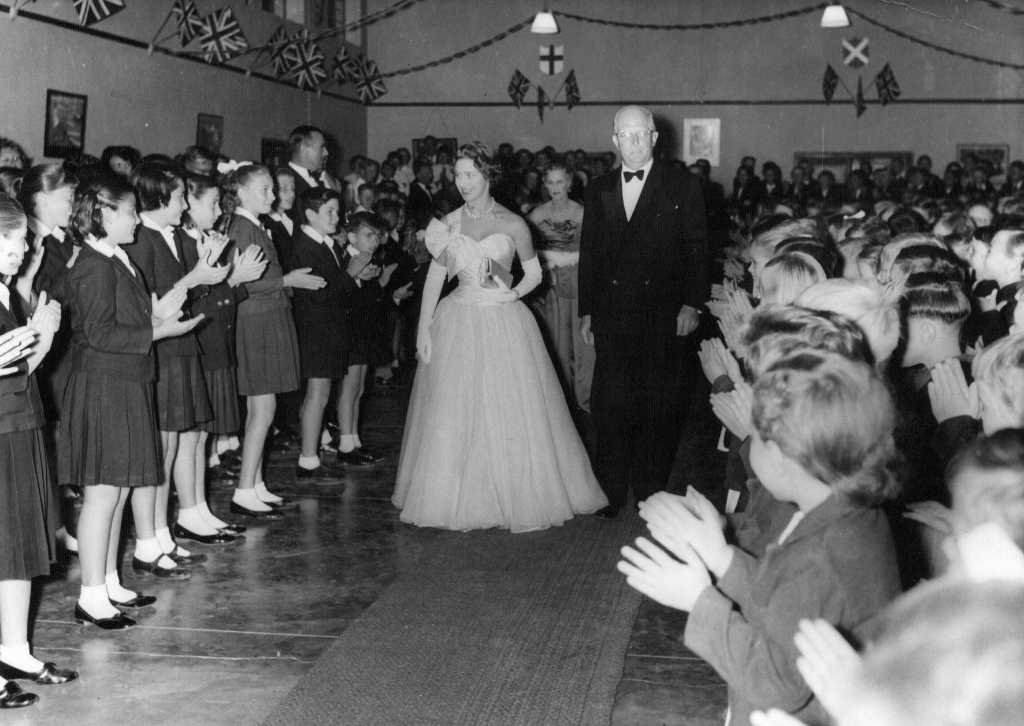
Official Photographer Photo of Princess Margaret's visit
Page Number: 1
Extract Date: 1956 Oct 19
See also
Arusha School Magazine
Page Number: 04-05
Extract Date: December 13, 1956

S.F. II
Margaret Masson
Aspasia Aslanis
S.F. I
Hadley Cooper
Brian Ulyate
Ronald Coxall
STANDARD IV
Joan Brewster
Erik Kullander
Susan Phibbs
STANDARD NA
Louis van Rooyen
Tessa Zaboronek
Yvonne Escott
STANDARD III
Ann Currie
Pamela Jeffery
Penelope Leslie
STANDARD IIIA
James Hallowes
Mary Sharp
Anna Aslanis
STANDARD II
Jennifer Kennedy
Julia Leslie
Jill Townsend
STANDARD IIA
Ian Fraser
Sally Ulyate
Leslie Haigh
STANDARD I
Penny Read
Geraldine Collings
Kirsten Jorgensen
ART AND H/WORK
David Woodbridge
STANDARD IA
Rognida Mogilnicki
Jan van Emmenis
Adriaan van Schoor
ART AND H/WORK
Trevor Pienaar
KINDERGARTEN II
Peter French
Fiona Masson
Daphne Eustace
ART AND H/WORK
Jonathan Snaith
KINDERGARTEN I
Alison Gunn
Wendy Brewster
David Sutherland
ART PRIZES
S.F. I and II
Teresa Rarogiewicz
IV and IVA Svend Bayer
III and IIIA Martin Guy
II and IIA
Jimmy Snee
NEEDLEWORK
S.F. I and II
Aspasia Aslanis
IV and IVA
Cathryn Berrington
PIANO
Cathryn Berrington Mary Adendorff
MRS. BREWSTER'S PIANO
Heidi Wolter
Penny Read
HANDWORK
S.F. II" Melville Ueckermann
S.F. I -- Hume Townsend
IV" Erik Jorgensen
IVA" Samuel Kilian
III" Jeanne de la Fontaine
IIIA" James Hallowes
II" Sally Freyburg
IIA" Elena Cuirleo
SCRIPTURE
S.F.II" John Hazel
S.F. I" Charles Hallowes
IV" Martin Darling
IVA" Marina Brink
III" Penny Leslie
IIIA" Ronnie Taylor
II" Geoffrey Jones
IIA" Ian Fraser
I" Meloena Didham
IA" Merlyn Holmes
NATURE STUDY
S.F. I and II" Erika Wolter
IV and IVA" Eugenia Sharpe
GAMES
SENIOR:
Margrit von Lekow
George Afentakis
MIDDLE :
Georgina Lambert
Geoffrey Jones
JUNIOR :
Sally Ulyate
Ryszard Bursztyn
ELOCUTION
.F. II" Valerie Ulyate, Marion Cleton
S.F. I" Margaret Hubbard
IV" Susan Phibbs
IVA" William Palmarini
III" Alison Bewes
IIIA" Peter Jones
II" Catherine Howard
IIA" Massy Swynnerton
I" Victoria Burnett
IA" Rognida Mogilnicki
HEADMASTER'S PRIZES
Margaret Masson
Valerie Ulyate
RASHA RASHA SHIELD
Valerie Ulyate
Melville Ueckermann
ANNE REVINGTON CUP
Teresa Rarogiewicz
DU TOIT CUP
Melville Ueckermann
SELIAN CUP
Robin Gemmell
LOVELL SHIELD FOR GUIDES
Daffodil Patrol
CUPS AND SHIELDS
Swimming" South
Hockey" North
Net ball" South
Soccer" North
Cricket" North
P.T." North
Rounders" North
Honour" North
Arusha School Magazine
Extract Author: Susan Phibbs (Aged) 11 years
Page Number: 25
Extract Date: March 1957
Local Study is done in the thrid term of the year and only by Standards IV and Iva. Before we went out for local study we were divided into four groups with about six people to each group and we usually go out on a Thursday morning. The first time I went on a local study was September 26th, 1956, when we went on a Township Survey. Each group leader chose two people to study a road one on each side. We had to see what the name of the shop was and what it sold, and then had to write it down in our book. The next place we went to was Daresco which is owned by Mr. Bayer. Daresco supplies the electricity for the whole town.
The same day we went to Amekas Macaroni Industry, which is owned by Mr. Stylianou. We saw the macaroni going through different kinds of pipes and machines, and Mr. Stylianou gave us a box of macaroni.
The next week was very exciting because we went to Oljoro for the day in a lorry. We went to three farms and went to a cattle auction and we had a picnic by a river. Then we went to Mr. Boardman's house where we had tea and a fishing contest. The next week we went to the Police Headquarters where we met Mr. Clogger who talked about the Police, then we went up to the Boma and had our finger prints taken, and looked round the Boma. The next Thursday we went to the P.W.D. which stands for Public Works Department, and we were shown round by Mr. Patient.
The next time we went on local study we went to the Town Hall where Mr. Green, the town clerk, talked to us about government. The next week we went to the Town Hall again. Then the last week we had on local study we went to the Boma again and were shown round by Mr. Jones. I think local study is a very interesting lesson.
Internet Web Pages
Extract Author: Mr. C. J. W. Hodgson
Page Number: 18, Vol 3
Extract Date: 12 Dec 1959
The Magazine of St. Michael's and St. George's School, IRINGA,Tanganyika,East Africa
To my Lords Bishop we also extend a sincere and cordial welcome, not only in your own person but also as representatives of the great Missions in which you serve. You have been the pioneers in founding and fostering education in Tanganyika. For this we are deeply grateful to you and I feel it is singularly appropriate that you, Bishop Chambers, should be here today as it is the silver jubilee year of the Arusha School which was the first European School to be built in Tanganyika and of which you, sir, were the founder.
nTZ Feedback
Extract Author: Wendy Sykes
Page Number: 2007 06 06
Extract Date: 1960's
I keep being drawn back to this site. What a powerful hold Arusha School and more generally our Tanzanian childhoods have over us still.
Diana and I have been remembering so many things. Our mother Barbara used to teach riding at the school. During our time as boarders we had so much freedom compared with the boarding school we attended when exiled to miserable, grey England in the 60s.
We also remember curry peas, gob stoppers and sugar daddies bought with pocket money on Saturday mornings and saved until the Saturday evening film.
We remember lockers in the corridors outside the dormitories, shoe cleaning in the quad where we also dried our hair after Saturday hair washing. We seemed to be allowed to wander all over the school grounds, playing down by the river, climbing trees, catching chameleons, sitting on the poor tortoise.
There were prickly pears outside the school which I seemed unable to resist and I remember the pain and irritation of the little spines when they stuck in your hand.
What about the San and soap enemas for poor unfortunates who were constipated?
There was a really nice convalescent garden where you were allowed to sit and read for a couple of days after you had been ill but before you rejoined the hurly burly of everyday life.
We remember PT on the field first thing, playing hockey in the afternoon, athletics and sports day, carols by candlelight at Christmas - holding real burning candles.
Mrs White was it who taught us singing? Does anyone remember the rain guage on the lawn outside the front of the school that someone went to read every day?
And what about the earthquake in 63(?) which I found very frightening especially when the whisper passed round the school that it was only the precursor to some more violent quake.
Our uncle Arthur Brown farmed Pyrethrum on Kilimanjaro with his wife Anne and three sons Peter, Rob and Micheal who were home schooled before going to Soni.
See also
nTZ Feedback
Page Number: 2008 05 22
Extract Date: 1965
Hi David,
I have a copy of the 1965 Arusha School Magazine and several other things includeing the Sports Day programme of the same year. I will scan and email you what I have. I kept a scrap book so lots of info in it from my years in Tanzania.
Cheers, Shaun
Nettelbeck, David A history of Arusha School, Tanzania
Page Number: 67
(for full details of this section click on the link on the right, and search for the appropriate page.)
The following order made by the Minister of Education under section 12 of the Education Ordinance,. 1961, hereby published for general information.
. . .
Title 1. This Order may-be cited as the Board of Governors Arusha School Order, 1965.
Internet Web Pages
Extract Author: Nettelbeck, David C
Extract Date: 1974
THESES record number: T1053
Title: A history of Arusha School, Tanzania
Author: Nettelbeck, David C.
Award: M.Ed.
Department: Education
Thesis: Thesis
University: University of Adelaide
Year: 1974
Location: SAEM RARE 371.009678 N473H
Subject Heading: UNIVERSITY OF ADELAIDE MASTER OF EDUCATION THESES [513]
Nettelbeck, David A history of Arusha School, Tanzania
Page Number: 00
Extract Date: 1974
Follow the link for a full version of the History - PDF file - 96 pages 320KB.
See also
Nettelbeck, David A history of Arusha School, Tanzania
Page Number: 06
Extract Date: 1974
Arusha School is one small school within the Tanganyika education system. It opened in 1934 for European children and now 40 years later is still catering for the children of expatriates workings in Tanzania.
The school was built by the Government and has always been owned by it in fulfilment of its aim to provide education for the children of settlers, officials, commercial managers and foreign experts. However the Government has directly managed the school for only 18 years of the 40 years of its history, and even then in close association with the Anglican Diocese of Central Tanganyika. For the other years, the Diocese has had either direct management responsibility or indirect management influence, but always the school has been financed by Government money and fees.
In order to understand the background of the various management agreements and to set the school in the total context of education in Tanganyika, this history looks in Chapter 1 at the broad sweep of the development of formal education from the German colonial administration in 1887 to the integrated system under the independent Government in 1962. Significant points in this evolving pattern are the British interpretation of the Mandate under the League of Nations and the uncertainty of European settlement; the Grant in Aid System of Government/Mission partnership in education introduced in the 1920s; the depression and economic recession of the 1930s and the three racially distinct educational systems for African, European and Indian children formalized in the 1940s and 1950s.
In Chapter II, the focus is narrowed from education as a whole to European education in particular. The Government, while not willing to take a lead, was willing to support those who did. Thus Bishop Chambers within the context of his concern for the pastoral care of Europeans opened a temporary school in 1928. This venture proved unsuccessful but led to negotiations for the Government to build a school and the Bishop to manage it using Government funds. Thus the Government could indirectly employ missionary staff at missionary rates of pay, a very economical proposition indeed during the post depression years.
Chapter III looks at the school in the first 12 years of its existence from 1934 - 1946 under its first Headmaster, Wynn Jones. He was an outstanding man whose loving, gentle personality and concern for people left an indelible impression on the school and a strong sense of family cohesion among boarders and staff alike.
In the 10 years under Wynn Jones, the enrolments grew from 30 to 120 pupils and the school outstripped the resources of the Diocese to staff it. A new agreement was therefore reached in 1946 under which the Government would directly manage the school, and employ staff, but the Diocese would have a strong and continuing involvement.
From 1946 to 1963 under the second major Headmaster Hamshere and a stable senior staff, the school expanded and became an efficient and somewhat impersonal yet vital and living community. Chapter IV looks at the personality of Hamshere, the curriculum and extra curricular activities and the exclusiveness of the "European" enrolment.
In 1961 the country gained its independence, followed in January 1962 by the abolition of separate European, Indian and African education departments.
This history is brought to a conclusion in 1969, 7 years after the integrated system of education became effective. During these years, the school returned to semi-Diocesan control under a Board of Governors and became an "international community" feeling its way very hesitantly to a place within independent Tanzania. In 1969, the post-independence Headmaster Bryn Jones left, the last of the British indent staff arrived, and the first of many missionary recruited teachers was employed on terms similar to those of 1934.
It is the belief of the writer that the character or tone of a school is very strongly determined by the nature of the staff and the leadership of the Headmaster. This history isolates the unique and contrasting personalities of two of the headmasters, Hamshere and Wynn Jones, who served the school for 28 years between them, and who left an indelible impression on it.
This history will also trace a rather unusual church-state relationship in the establishment and management of Arusha School. This relation-ship developed partly in an attempt to stretch scanty government funds as widely as possible; and partly in a genuine attempt to personalize what could have become a formal academic machine, and to bring a more spiritual and human dimension into an otherwise harsh and uncultured "frontier" and "colonial" environment.
Marsh, Colin Private Diary
Extract Date: 1994
David had only just mentioned about the Giant Tortoise he used to play with, when, coming out, there it was - 40 years later - what an incredible sight to see, and a wonderful animal. On returning to Zambia I [Colin] meet Charles Lasierre who went to the school about 1940, and the tortoise was there then.
See also
Arusha Times
Extract Author: Nyamanoko Bwire
Page Number: 275
Extract Date: 20 June 2003
Student participants during the inter-school athletics event at the ISM, Arusha Campus
Arusha School has once more topped inter-school games and this time it was athletics competitions held at the Arusha Campus of International School Moshi (ISM).
The government owned English medium school, stood tall, fresh from winning yet another trophy at a cross country race held at Braeburn School two weeks ago.
One of the school pupils, Airath Mushi shone in shot put throwing in the event which had over eight athletic games.
Saint Thomas School of Moshono, new as it is, managed to top the relay race category. The school was third in the previous Braeburn cross country race.
International School of Moshi (ISM), Arusha Campus was second in the last week's athletics events, being followed by St. Thomas, then Braeburn and finally St. Constantine.
The relay events included; 100 metres race, 200 metres, 400 metres, 800 metres and 1500 metres races plus relays short puts and tugs of wars.
Arusha School's own annual sports day, is expected to take place in mid-July.
See also
Arusha Times
Extract Author: Hamza Kalmera
Page Number: 280
Extract Date: 26 July 2003
Arusha School, plans to invest over Tsh.18 million to renovate the English medium primary school's sports grounds.
School headmaster, Melchior Kiduma, said the amount will also cover the cost of buying new, or replacing old sporting equipment.
Speaking during the school's annual sports day, Kiduma said lack of proper sporting grounds and arenas and inadequate facilities in form of equipment have for quite some time been hindering extra-curricular activities at the government-owned school.
The headmaster, explained that, the money for the project come from the special extra-curriculum development fund in schools of the Ministry of Education.
However, more funds are expected to be raised from special contributions to be donated by individuals, companies and parents stakeholders of the school.
Arusha School, the first English medium primary school in Tanzania has a variety of sporting activities such as horse racing, swimming, ball games and athletics.
nTZ Feedback
Extract Author: Anoop Nathwani
Page Number: 2004 12 20
Extract Date: 20 Dec 2004

hello
i have already written a few words dates in february 2004
i was in Arusha School btn the years 1984-1989 and now that i m residing in the uk...i mis those lovely days and that lovely town too that i m always and will always be associated with
pls do find the attached photo of the kobe that one of my cousin who stays in arusha took it for me
when ever i get the chance to go to east africa i make a point to go ans visit the school
how it has changed those lovely old tress been cut down...but still it brings the good old times i had
if ther is anyone during those times pls do pass them my email.
thanking you in advance
Anoop
See also
Holland, Rodney Trip to Tanzania
Page Number: 0
Extract Date: August 2005
Our visit to Tanzania was a great success it appears that everyone enjoyed it even though we did cram a lot in in such a short time.
On arriving . . . And depositing our bags we went off to Arusha School to arrange our visit for later in the week. However when we got there fortunately the head master was there and one of the teachers . They very kindly took us around there and then. The headmaster was thrilled to see us particularly as my sister and myself were old students from the school.
When I showed him my name on the Mt.Meru conquered board he became very excited since it was 50 years ago! We had a good look around the school and our impressions were that it had not changed a lot from when we were there but it was certainly in need of some repair and maintenance.
The dorms appeared quite cramped as they had put bunkbeds in them and they could do with new mattresses.
The swimming pool was in need of a complete overhall.
We noticed that the headmasters house at the beginning of the drive to the school had been demolished by a falling eucalyptus tree fortunately no one was in it. However as a result they have cut down all those lovely big eucalyptus trees along the drive. I wonder if there is any way funds can be raised for the school?
The school seemed to be a happy place, all the children we met seemed to really enjoy their life there which was very nice to see.
I am attaching some photos of the school which I think are self explanatory however I will just list them as follows
See also
Holland, Rodney Trip to Tanzania
Page Number: 1
Extract Date: August 2005

See also
Holland, Rodney Trip to Tanzania
Page Number: 2
Extract Date: August 2005

See also
Holland, Rodney Trip to Tanzania
Page Number: 2a
Extract Date: August 2005

See also
Holland, Rodney Trip to Tanzania
Page Number: 3
Extract Date: August 2005

See also
Holland, Rodney Trip to Tanzania
Page Number: 4
Extract Date: August 2005

Holland, Rodney Trip to Tanzania
Page Number: 5
Extract Date: August 2005

See also
Holland, Rodney Trip to Tanzania
Page Number: 6
Extract Date: August 2005

See also
Holland, Rodney Trip to Tanzania
Page Number: 7
Extract Date: August 2005

See also
Holland, Rodney Trip to Tanzania
Page Number: 8
Extract Date: August 2005

See also
Holland, Rodney Trip to Tanzania
Page Number: 9
Extract Date: August 2005
Summing up it was nice to see the school again after so many years and it was surprising how many of the original buildings were still there and being used and to their full capacity.It would be nice if there was some means that as old students we could help in the repair and maintenance of the school.
. . .
Arusha Times
Extract Author: Matilda Kirenga
Page Number: 442
Extract Date: 21 Oct 2006

Arusha School was last week presented with 10 computers, courtesy of Arusha's Regional Medical Officer, Dr. Naftal Ole King�ori.
Dr. King�ori was fulfilling a promise that he floated during last year's graduation ceremony at the school which he officiated as guest of honour. He promised to provide the school with one computer but he eventually came up with 10.
The school which is government run and one that had a reputation of affluence and high rank academically, had only one computer before receiving the donation. Teachers of the school also had computer training but had no access to computers.
Dr. King�ori urged the students to make good use of the computers because computer skills are essential in job markets in all sectors.
The donation was made possible through the support of Computer Aid International of United Kingdom and Computer for Schools, Kenya.
See also
nTZ Feedback
Extract Author: Gaynor Watkins
Page Number: 2007 02 16e
Extract Date: 2007

The fourth picture is of the school building my father built - used to called Watkins Hall.
See also
nTZ Feedback
Extract Author: Ronald Lwakatare
Page Number: 2008 04 24
Extract Date: 24-Apr-2008
Miss Ngowi, currently the longest serving teacher, is retiring as a teacher this year 2008.
I recently (February 2008) visited the school and had talks with Ms. Ngowi, the Headmaster Mr. Kaniki and Music Teacher Mr. Liheta at different times.
We have in principle agreed to have a music show in Dar towards the end of this year in honour of Ms. Ngowi.
I think the success of the event will depend on willingness of fellow alumni to participate in the preparations.
We need to find a venue, accomodation for the students (most will be at their parents homes) etc. For those interested please let us be in touch. My mobile is 0754268568.
The school is currently undergoing major rehabilitation. I saw the kitchen, swimming pool, laundry place being rehabilitated. The bathrooms now have solar power heaters for hotwater. I am informed that rehabilitation is going on and will also cover the assembly hall etc.
If you get time while in Arusha try to pass by and see the school.
See also
nTZ Feedback
Extract Author: anoop nathwani
Page Number: 2007 12 05
have you ever thought of having a reunion for the year 2009?
there are two groups on Arusha School,A R U S A H SCHOOL on facebook...which is the most widespread medium being used til date...
with the help of facebook i personaly have met so many of my friends...one being whom i just parted a day ago...and one being whom i had parted some 22 years ago.
we were all catching up on the time lost...and were wondering of a reunion in year 2009.
what do you have to suggest and what do you think about it?
please do reply as soon as you receive this mail...i think its an approriate time if need be for the reunion...with having in mind of only 25 more years to go for 100 years ,we can meet up with all the right people,organisation,for uplifting,re-establishing,and some sort of bringing the average standard of our beautiful school.
yours hopeful
anoop nathwani
1979-1985